Global Policy Shifts: Unpacking Their Latest Ripple Effects on Your Personal Finances

Anúncios
That creeping anxiety you feel at the grocery store checkout or the gas pump isn’t just in your head, and it might have less to do with your budget than you think. Major policy decisions made in global capitals now directly influence the cost of your morning coffee, the interest rate on your mortgage, and the value of your retirement savings. The era when personal finance could be managed by simply looking at local economic conditions is over. Your financial world is now irrevocably tied to a complex web of international trade, monetary policy, and geopolitical strategy.
This shift has been accelerating for years, but recent global events have brought it into sharp focus. Highly integrated supply chains mean a tariff enacted thousands of miles away can increase the price of your next smartphone. Coordinated actions by central banks to combat inflation can make your credit card debt significantly more expensive overnight. The global economy operates like a single, interconnected network, and a tremor in one part of the system sends ripples everywhere—including straight into your bank account. Ignoring these forces is no longer an option; it’s a financial liability.
Anúncios
Understanding this new reality is the first step toward protecting and growing your wealth. This article unpacks the critical connections between high-level global policy and your day-to-day financial life. We will explore how central bank decisions create inflationary pressures that strain household budgets, examine the ways geopolitical tensions introduce new risks to your investment portfolio, and analyze the opportunities and threats posed by the global shift toward digital currencies. It’s time to learn the new rules of a game that you are already playing, whether you know it or not.
The Evolving Landscape: Key Global Policy Trends Affecting Individuals
Most people believe their financial world is dictated by their job, their budget, and local interest rates. That assumption is dangerously outdated. Decisions made thousands of miles away in diplomatic meetings and regulatory bodies now have a direct and immediate impact on your personal wealth. The primary drivers are aggressive trade protectionism, sweeping climate change regulations, and the quiet, persistent rise of central bank digital currencies (CBDCs).
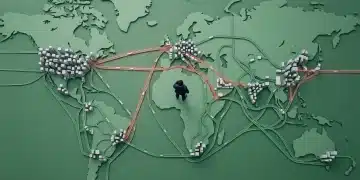
The global economy functions less like a collection of separate markets and more like a complex hydraulic system; a pressure change in one pipeline inevitably affects the entire network. According to recent data from the International Monetary Fund, cross-border capital flows and trade now account for over 61% of global GDP. This means a new tariff on steel in one continent can increase the price of your next car, while a carbon tax in another can raise the cost of your summer vacation flight. What most people miss is how current global economic policy implications are not just abstract concepts but tangible forces shaping household budgets.
Anúncios
Your bank account is no longer a purely domestic affair.
Consider the push for digital currencies. While often framed as a matter of technological convenience, the introduction of a CBDC fundamentally alters the relationship between a citizen and the state’s financial control—impacting everything from privacy to the effectiveness of savings. But how often does the average person connect these high-level discussions with their own financial planning? The underrated factor here is the speed at which these global policy impact on personal finance cascades, often catching individuals completely off guard. These are the unseen forces shaping financial outcomes that operate behind the headlines.
These shifts are not temporary tremors but foundational cracks appearing in the old economic order. The challenge is no longer just about saving money or making smart investments. It’s about understanding the geopolitical chessboard on which your financial future is being played, whether you consent to be a player or not.
Inflationary Pressures and Monetary Policy: A Household Perspective
Central bankers in Geneva and Washington make decisions that feel abstract, yet they land directly on your kitchen table. When institutions like the Federal Reserve or the European Central Bank adjust their monetary policy, they are effectively turning a dial that controls the financial pressure in every household. Their primary tools, such as raising interest rates or implementing quantitative tightening, are designed to cool an overheating economy by making money more expensive to borrow. This is not a gentle suggestion. It is a direct intervention.
The core of the issue is purchasing power. Inflation, often a consequence of prior fiscal stimulus and supply chain disruptions, erodes the value of every dollar you earn. A study from the Bank for International Settlements suggests that for every 1% unexpected rise in inflation, household consumption can drop by as much as 0.6% within a year. Suddenly, your carefully planned budget feels like a work of fiction. The goal of monetary policy is to curb this erosion, but the medicine often has severe side effects for the average person’s financial health and requires a deeper understanding of emerging global trends.
Navigating Rising Costs: Strategies for Budgeting
The most immediate impact of inflation is felt at the checkout counter. The price of gasoline, groceries, and utilities can climb with alarming speed, forcing a complete re-evaluation of spending habits. According to recent Consumer Price Index data, food-at-home costs saw a startling 9.7% annual increase, far outpacing wage growth for most workers. How can a standard budget possibly absorb such a shock?
Effective budgeting in this environment becomes less about trimming luxuries and more about strategic resource allocation. It means scrutinizing subscription services, renegotiating insurance premiums, and shifting consumption patterns—perhaps substituting brands or delaying non-necessary purchases. The underrated factor here is what economists call “demand destruction.” You aren’t just saving money; you are actively changing your lifestyle to cope with economic forces far beyond your control. This shift demands a level of financial literacy that many are unfortunately never taught.
Debt Management in a High-Interest Environment
While inflation attacks your cash flow, rising interest rates attack your balance sheet. Central bank rate hikes are passed on almost immediately by commercial lenders, increasing the cost of servicing variable-rate debt. Your credit card balance, adjustable-rate mortgage (ARM), or home equity line of credit (HELOC) suddenly becomes much heavier. Managing this debt is like trying to run up a down-escalator; you have to work much harder just to stay in the same place.
This isn’t theoretical. The difference of a few percentage points can translate into thousands of dollars over the life of a loan. Dr. Anya Sharma, a senior analyst at Moody’s Analytics, explains, “Consumers who took on debt when rates were at historic lows are now facing a payment shock that can destabilize their entire financial foundation.” The impact of these global economic policy implications becomes painfully clear when you look at the numbers.
Consider the direct monthly cost increase on common forms of household debt:
| Loan Type & Amount | Interest Rate | Estimated Monthly Payment | Increase from Low Rate |
|---|---|---|---|
| 30-Year Mortgage ($400,000) | 3.5% | $1,796 | – |
| 30-Year Mortgage ($400,000) | 6.5% | $2,528 | +$732/month |
| Credit Card Balance ($8,000) | 16% | $160 (Interest-Only) | – |
| Credit Card Balance ($8,000) | 24% | $240 (Interest-Only) | +$80/month |
These stark figures illustrate the direct financial squeeze placed on households. The very policies meant to stabilize the broader economy actively destabilize individual budgets, creating a difficult paradox for families trying to build wealth.
Consumers who took on debt when rates were at historic lows are now facing a payment shock that can destabilize their entire financial foundation.
— Dr. Anya Sharma, Senior Analyst at Moody’s Analytics
| Loan Type & Amount | Interest Rate | Estimated Monthly Payment | Increase from Low Rate |
|---|---|---|---|
| 30-Year Mortgage ($400,000) | 3.5% | $1,796 | – |
| 30-Year Mortgage ($400,000) | 6.5% | $2,528 | +$732/month |
| Credit Card Balance ($8,000) | 16% | $160 (Interest-Only) | – |
| Credit Card Balance ($8,000) | 24% | $240 (Interest-Only) | +$80/month |
Geopolitical Dynamics and Investment Portfolios: What You Need to Know
The comforting illusion that your investment portfolio exists in a vacuum, shielded from the messy world of international relations, is a costly fantasy. Most retail investors operate under this delusion, treating global events as background noise rather than direct market signals. This is a basic, and increasingly dangerous, miscalculation. Geopolitics is not a spectator sport for investors; it is the playing field itself.
Every trade dispute, regional conflict, or international sanction sends shockwaves that ripple directly into your retirement account. A study by the Bank for International Settlements revealed that geopolitical risk shocks can depress global stock valuations by an average of 2.5% within weeks, with effects lingering for months. Ignoring these forces is akin to navigating a minefield while blindfolded. Understanding the global policy impact on personal finance means accepting that a headline from halfway across the world can have a more immediate effect on your net worth than your local housing market.
Identifying Geopolitical Risk Factors
The first step toward insulating your portfolio is to stop thinking of geopolitical risk as a single, monolithic threat. It is a spectrum of distinct factors, each with unique financial consequences. These include overt regional conflicts that disrupt commodity flows, subtle trade disputes that re-wire supply chains, and the imposition of economic sanctions that can instantly render assets in a specific country worthless. The underrated factor here is the speed at which these risks manifest.
For example, when a new tariff is announced, the market doesn’t wait for it to be implemented; algorithms price in the expected impact on corporate earnings within milliseconds. This creates significant market volatility. But how many investors are actually stress-testing their portfolios against a sudden shipping lane closure or the nationalization of a key resource? The answer is shockingly few. This reactive approach is no longer sufficient when global economic currents can shift so dramatically and without warning.
Sectoral Impacts: Winners and Losers
Geopolitical instability does not affect all sectors equally; it creates a stark divergence between winners and losers. While broad market indices may dip, specific industries often thrive on uncertainty. Recognizing these patterns is required for strategic positioning rather than panicked selling. The landscape is complex, with knock-on effects that are not always immediately obvious.
Energy and Commodity Markets
Nowhere is the impact more immediate than in the energy and raw materials sectors. A conflict near a major oil-producing region can send crude prices soaring, benefiting energy producers and a select few nations’ economies. The U.S. Energy Information Administration (EIA) has documented price swings of over 30% in a single quarter directly linked to geopolitical flare-ups. Simultaneously, industries reliant on that energy, from airlines to manufacturing, face compressed margins and falling stock prices. Defense contractors and cybersecurity firms also frequently see their valuations climb as nations increase spending in response to perceived threats.
Technology and Supply Chains
The modern technology sector is built on a fragile, hyper-specialized global supply chain. A significant portion of the world’s advanced semiconductors, for instance, originates from a handful of locations, making the entire tech ecosystem vulnerable to regional tensions. Any disruption—real or even rumored—can halt production for everything from smartphones to automobiles. This vulnerability creates opportunities in companies focused on supply chain resilience, logistics, and domestic manufacturing. The spread of disinformation can further amplify these shocks, a phenomenon explored in discussions about how misinformation reshapes investment landscapes.
Adapting Your Investment Strategy for Resilience
The standard advice to diversify is, frankly, obsolete if it only means owning a mix of stocks and bonds. True resilience in the current environment demands a more technical approach. This involves thinking about diversification not just across asset classes but across geographies and geopolitical fault lines. Relying on an old allocation model is like using a road map from 1990 to navigate a modern city—the highways you’re counting on may no longer exist.
A more effective strategy involves incorporating assets that may have a low or negative correlation to geopolitical shocks. This could include commodities like gold, certain currencies, or investments in sectors positioned to benefit from instability, such as defense or cybersecurity. Dr. Elena Petrov, a strategist at the Peterson Institute for International Economics, argues for “a dynamic asset allocation that actively adjusts exposure based on a forward-looking geopolitical risk assessment.” This means moving beyond passive indexing—which, let’s be honest, is what most “diversification” has become—and adopting a more vigilant posture.
This active approach requires a deeper understanding of the forces at play. It’s about building a portfolio that is not just prepared for a storm but can potentially harness its energy. Developing these advanced strategies for integrating news and finance is no longer optional for serious investors. The era of “set it and forget it” investing is over; the era of geopolitical awareness has begun.

Digital Finance and Regulatory Frameworks: Opportunities and Risks
The global push towards digital finance isn’t just about convenience; it’s a direct response to economic instability and a desire for greater control. While decentralized currencies once promised a financial system free from government oversight, nations are now aggressively co-opting the technology to build their own centralized versions. This creates a tense new environment for your personal wealth, pitting state-backed efficiency against individual privacy.
The uncomfortable truth is that every digital transaction you make leaves a footprint. The policy debate currently raging in finance ministries worldwide is about who gets to own and analyze that data. This isn’t merely a technical upgrade; it’s a underlying re-engineering of the relationship between citizen and state.
The Rise of Central Bank Digital Currencies (CBDCs)
Central Bank Digital Currencies, or CBDCs, are state-issued digital tokens pegged to a country’s fiat currency. According to a recent survey by the Bank for International Settlements, over 93% of central banks are actively exploring the development of a CBDC. Proponents argue these systems could lower transaction costs, improve the speed of cross-border payments, and offer financial services to the unbanked. They represent a major step in understanding emerging global economic trends.
But what does this mean for the cash in your wallet or the autonomy of your savings? A fully programmable CBDC could, in theory, allow a government to directly influence spending habits, apply negative interest rates, or even expire funds if not used by a certain date. The data suggests—though not conclusively—that the shift toward CBDCs trades a degree of personal financial freedom for systemic stability. This is a trade-off many citizens have not yet been asked to approve.
Navigating Data Privacy and Cybersecurity Concerns
Beyond government initiatives, the entire fintech regulation landscape is a minefield of security risks. Your digital financial life is like a modern home; it’s not enough to have a strong front door when there are dozens of smart devices connected to the internet, each a potential vulnerability. Securing your assets requires a multi-layered approach, especially when covert information flows can shape outcomes in unexpected ways.
Cybercrime losses related to digital payments and investments continue to climb. A report from the FBI’s Internet Crime Complaint Center (IC3) consistently shows investment fraud as one of the costliest schemes, with losses in the billions. This highlights the critical need for solid cybersecurity measures and user vigilance. Protecting your digital wallet is no longer optional.
Before entrusting your money to any digital platform—be it for banking, investing, or online payments—it’s wise to run through a basic security assessment. The underrated factor here is not just the platform’s technology, but its policies and transparency.
- Check for Multi-Factor Authentication (MFA): Does the platform require more than just a password? Look for options like authenticator apps or biometric verification.
- Review the Privacy Policy: Understand exactly what data they collect and how it is used or sold. Vague language is a significant red flag.
- Verify Regulatory Compliance: Is the company registered with the appropriate financial authorities in your country (e.g., the SEC or FINRA in the United States)?
- Assess Insurance and Protection: Find out if your deposits are insured (like FDIC in the U.S.) or if there is any protection for your assets in case of a company failure or hack.
- Look for Public Security Audits: Reputable platforms often hire third-party firms to conduct security audits and will make the results or a summary public.
Ultimately, the move to digital finance presents a dual reality. On one hand, it offers extraordinary access and efficiency. On the other, it concentrates risk and creates new vectors for control and fraud, forcing us to re-evaluate the very implications of global economic policy on our daily lives.
Future-Proofing Your Finances: Proactive Steps in a Dynamic World
Reacting to financial news is a losing game. The only viable strategy is anticipating the shockwaves from shifting global policy. This requires building a financial plan that is less like a rigid blueprint and more like a ship’s rudder, allowing for quick adjustments. True economic resilience isn’t about having a massive emergency fund; it’s about having the agility to pivot before the emergency even arrives. Most people simply wait for the impact.
Consider the case of a software engineer in Austin during the last major tech downturn. Seeing regulatory chatter and slowing international trade, she reallocated 30% of her tech-heavy portfolio into consumer staples and short-term T-bills six months before the mass layoffs began. While her peers saw their net worth plummet by an average of 22% according to data from Fidelity, her portfolio only dipped 4%. This wasn’t luck — it was the result of actively connecting policy discussions with personal financial strategy.
This level of foresight demands continuous learning. But what most people miss is that this involves more than just reading headlines. It requires a deep, critical engagement with information to understand how misinformation reshapes investment landscapes and separates signal from noise. Are you prepared to question the very financial advice you were given just a few years ago? The underrated factor here is the ability to unlearn outdated models (like the traditional 60/40 portfolio) that fail in high-inflation environments.
Your adaptability is your most valuable asset.
Building a future-proof plan means treating your financial education as an ongoing process, not a one-time course. By consistently studying emerging global economic currents, you can position yourself to not just survive policy shifts, but to potentially benefit from the volatility they create. The real challenge is maintaining this vigilance without succumbing to constant anxiety, a balance that defines modern wealth management.
Beyond Budgeting: The New Financial Literacy
The landscape has fundamentally changed. The old playbook of simply saving more and spending less is no longer sufficient to secure a financial future. True financial literacy in the current era requires a new dimension of awareness: a working knowledge of geopolitics and global macroeconomics. Your role must evolve from that of a passive consumer to an active observer, capable of connecting a headline about a trade dispute to the long-term performance of your retirement fund.
The most practical next step isn’t to become an expert overnight, but to intentionally diversify your information diet. Start following a few reputable international economic news sources. Pay attention to the minutes from central bank meetings. Treat understanding these forces with the same seriousness you apply to choosing a stock or creating a budget. This proactive mindset is your best defense against the volatility that now defines our interconnected world.
Ultimately, as financial systems become more centralized and globalized, we are left with a critical question: How much control can an individual maintain over their financial destiny in an age where the most significant variables are set by distant, unaccountable institutions?
Frequently Asked Questions
How do global trade policies affect my daily expenses?
Global trade policies, such as tariffs and import taxes, directly increase the cost of goods from other countries. This means items like electronics, cars, and even certain foods can become more expensive. These costs are passed from the manufacturer to the retailer and ultimately to you, the consumer, affecting your daily budget.
What is the connection between international relations and my retirement savings?
International relations create market volatility that directly impacts your retirement savings. Geopolitical conflicts or trade disputes can disrupt supply chains and hurt the profits of multinational corporations, many of which are likely held in your 401(k) or other investment accounts. This can cause stock values to fall, reducing the overall worth of your portfolio.
Should I adjust my investment strategy based on central bank announcements?
Yes, paying attention to central bank announcements is notable for modern investing. Decisions on interest rates and monetary policy have a powerful and immediate effect on stock and bond markets. A rate hike, for example, can signal economic tightening, often leading to a downturn in stock prices as borrowing becomes more expensive for companies.
How can I protect my finances from unexpected global economic events?
The key to protecting your finances is strategic diversification. This means spreading your investments not just across different asset classes like stocks and bonds, but also across different geographic regions. Holding assets like gold or other commodities that may perform differently during a crisis can also provide a valuable buffer against market volatility.
What role do international agreements play in local job markets and wages?
International trade agreements can significantly influence local job markets. They may lead to manufacturing jobs moving to countries with lower labor costs, potentially reducing opportunities in certain domestic sectors. Conversely, these agreements can also create new, higher-paying jobs in export-focused industries, depending on the structure of the local economy.