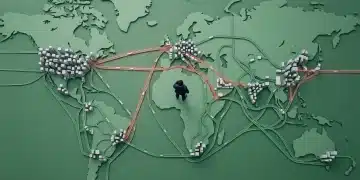
Decoding Global Economic Currents: Emerging Trends and Their Impact

Anúncios
The familiar rhythms of the global economy—predictable trade cycles, stable alliances, and incremental technological progress—are fading into history. We’ve entered an era of profound and often jarring transformation, where the foundational principles of finance and commerce are being rewritten in real time. Understanding these global economic shifts is no longer a passive exercise for economists; it’s an active necessity for anyone looking to protect their assets, grow their business, or simply make sense of the world.
This restructuring isn’t driven by a single event but by the powerful convergence of three distinct forces. First, rapid technological disruption, led by artificial intelligence and decentralized finance, is fundamentally altering labor markets and the nature of currency. Second, a sharp geopolitical realignment is fracturing the post-Cold War consensus on globalization, forcing a retreat into regional economic blocs and resilient, if more expensive, supply chains. Finally, the urgent transition toward a green economy is reallocating trillions of dollars, creating new industrial titans while threatening to leave unprepared sectors behind.
Anúncios
Navigating this new landscape requires a different map. This article decodes these complex currents, moving beyond the headlines to analyze the underlying mechanics of change. We will explore how AI is reshaping productivity, why ‘friendshoring’ is replacing ‘just-in-time’ efficiency, and what the rise of sustainable finance means for investors and businesses. The goal is to provide a clear framework for interpreting volatility and identifying the opportunities hidden within the disruption.
The New Global Economic Landscape: Defining Key Shifts
Forget the predictable, cyclical economic models taught in textbooks. The established patterns of global trade and investment are fracturing under immense pressure, creating an entirely new economic map. Understanding these global economic shifts is no longer an academic exercise; it is a underlying requirement for survival. These are not minor tremors. They represent a foundational restructuring of the world’s financial architecture.
Three primary forces are driving this transformation: rapid technological displacement, a sharp geopolitical realignment away from globalization, and extraordinary demographic pressures. The data suggests—though not conclusively—that the decoupling is accelerating. According to a recent World Bank analysis, cross-border capital investment in key tech sectors saw a 22% decline between rival economic blocs. This fragmentation reshapes everything from supply chains to the very nature of global economic policy implications.
Anúncios
The old system operated like a predictable train schedule; the new one is more like a chaotic city bus network with constant reroutes. But what does this volatility actually mean for asset valuation and risk? The underrated factor here is the speed at which capital can now exit a market—a velocity that many current models fail to account for properly. This environment demands a deeper, more adaptive form of financial literacy to navigate.
The macroeconomic trends we track today have shorter lifespans and greater potential for contagion, challenging investors and policymakers to anticipate what’s next in this evolving landscape.
Technological Disruptions and Economic Reconfiguration
The relentless march of technology is no longer just an accessory to economic activity; it is the primary force actively dismantling and rebuilding foundational economic structures. While commentators focus on incremental changes, what most people miss is the speed and scale of this reconfiguration. Forces like artificial intelligence, automation, and blockchain are not simply creating efficiencies—they are fundamentally altering labor markets, rewriting the rules of global trade, and challenging the very nature of currency itself.
AI and Automation: Reshaping Labor and Productivity
The dual promise and peril of AI and automation present one of the most significant challenges to modern economies. On one side, the potential for productivity gains is staggering. A recent analysis by Deloitte suggests that targeted AI integration can boost labor productivity by up to 40% in certain sectors within a decade. This technology can optimize complex supply chains, accelerate drug discovery, and manage energy grids with a precision far beyond human capability.
This efficiency, comes at a steep and controversial price. The displacement of human labor is not a distant threat but a present reality. While new roles in data science and AI ethics are emerging, are they appearing fast enough to absorb the millions of jobs in transportation, manufacturing, and customer service that are at risk? The data suggests a growing chasm between high-skill and low-skill workers, creating not just unemployment but a structural shift that demands new economic opportunities and educational models.
Consider the transformation in logistics. Automated warehouses operated by companies like Ocado use thousands of robots to fulfill grocery orders, reducing processing time from hours to minutes. This system is a marvel of engineering. But it also renders entire categories of human labor obsolete.
Blockchain and Digital Currencies: A New Financial Frontier
Beyond the speculative frenzy of cryptocurrencies lies blockchain, a technology with the potential to rebuild finance from the ground up. At its core, a blockchain is a distributed ledger that offers a secure and transparent way to record transactions — a kind of digital notary that no single entity controls. The underrated factor here is its ability to create trust in systems without a central intermediary, a function historically monopolized by banks and governments.
This technology directly threatens the established financial order by enabling decentralized finance (DeFi), where lending, borrowing, and trading occur on open networks without traditional banks. The Bank for International Settlements reports that the total value locked in DeFi protocols has frequently surpassed $90 billion, a small but rapidly growing fraction of the global financial system. This shift forces a complete re-evaluation of global economic policy, as central banks grapple with a loss of control over monetary levers.
Still, this new frontier is fraught with risk. Regulatory ambiguity, persistent security vulnerabilities, and the environmental cost of some blockchain networks remain significant barriers to mainstream adoption. The very transparency that defines blockchain also creates new challenges for understanding how information flows shape finance. The conflict between centralized financial stability and decentralized innovation is far from resolved.
For decades, we built supply chains for perfect conditions and maximum efficiency. The new imperative is to build them for reality—a reality defined by disruption and uncertainty.
— Global Supply Chain Analyst
| Driving Force | Key Manifestation | Primary Impact |
|---|---|---|
| Technological Disruption | AI-driven automation and Decentralized Finance (DeFi). | Reshapes labor markets, challenges traditional banking, and creates new productivity frontiers. |
| Geopolitical Realignment | ‘Friendshoring,’ regional trade blocs, and supply chain resilience. | Moves focus from pure cost efficiency to security and stability, increasing operational costs. |
| Green Economy Transition | Rise of ESG investing and sustainable finance mandates. | Reallocates trillions in capital toward renewable energy and away from fossil fuels, creating new market leaders. |
Geopolitical Dynamics and Trade Realignment: A Comparative Analysis
The comfortable assumption of ever-expanding, frictionless global trade has been shattered. We are now witnessing a underlying realignment where political alliances and national security concerns actively steer economic currents, often overriding pure market logic. This shift is not a temporary disruption; it represents a new chapter in the history of international commerce, one defined by strategic competition rather than simple cooperation.
Shifting Alliances and Their Economic Ramifications
Nations are increasingly coalescing into economic blocs, using trade policy as both a shield and a sword. The focus has pivoted from universal access to preferential treatment for allies, creating a fragmented global market. Foreign Direct Investment (FDI) flows starkly illustrate this trend. Data from the International Monetary Fund suggests a 19% decline in cross-border investment between rival geopolitical blocs over the last five years, while investment among aligned nations has remained steady. What most people miss is how this creates insulated economic ecosystems, where access to technology, capital, and resources is determined more by your country’s flag than your company’s balance sheet.
This reality forces multinational corporations into difficult, often costly, decisions. Operating a global business now requires navigating a complex web of sanctions, tariffs, and competing regulatory standards. It’s a strategic minefield. The data suggests—though not conclusively—that the full economic cost of this decoupling is still being massively underestimated in corporate forecasts and market valuations.
The Evolution of Global Trade Agreements
Modern trade agreements look different from their 20th-century predecessors. While older pacts like GATT aimed for broad tariff reductions, contemporary agreements such as the detailed and Progressive Agreement for Trans-Pacific Partnership (CPTPP) and the United States-Mexico-Canada Agreement (USMCA) are far more intricate. They delve into digital trade, intellectual property rights, and labor standards, often embedding geopolitical objectives within their clauses. But are these pacts fostering genuine cooperation or simply drawing new battle lines for economic influence?
These agreements are less about a rising tide lifting all boats and more about building stronger flotillas for specific alliances. The intricate rules of origin and non-market economy clauses are clear signals that participation is conditional. Understanding the nuances of global economic policy is no longer just for economists; it’s a critical skill for any investor or business leader trying to anticipate the next major market shift.
Resilience vs. Efficiency: Redefining Supply Chain Strategies
For decades, the guiding principle of supply chain management was “just-in-time” efficiency, a model that prioritized cost reduction above all else. This approach treated the global supply chain like a high-performance race car—incredibly fast on a perfect track but completely disabled by a single unexpected pothole. The pandemic, geopolitical spats, and even a single ship stuck in a canal revealed the profound fragility of this system. Efficiency is no longer king.
The new imperative is resilience. This means building redundancy, diversifying suppliers, and holding more inventory—actions that directly contradict the lean manufacturing gospel. The trade-off is stark: higher operational costs in exchange for the ability to withstand shocks. The table below highlights key vulnerabilities that have been reassessed.
| Vulnerability Point | Pre-Pandemic View (Efficiency-Focused) | Post-Pandemic View (Resilience-Focused) |
|---|---|---|
| Supplier Concentration | Ideal for economies of scale and cost reduction. | A significant single point of failure; requires diversification. |
| Inventory Levels | “Just-in-time” minimizes holding costs. | “Just-in-case” buffer stock is now a strategic necessity. |
| Geographic Proximity | Sourcing from the lowest-cost region, regardless of distance. | Nearshoring and regionalization are prioritized to shorten lead times. |
| Information Flow | Focused on order tracking and logistics. | Expanded to include geopolitical risk monitoring and supplier viability. |
Nearshoring and Friendshoring Trends
In response to these vulnerabilities, two dominant strategies have emerged: nearshoring and friendshoring. Nearshoring involves relocating manufacturing and sourcing to countries geographically closer to the end market—for example, U.S. companies moving production from Asia to Mexico. Friendshoring is more political, restricting supply chain networks to allied countries that share similar values and geopolitical interests, even if they aren’t the cheapest option.
This isn’t just theory. A recent report from the consulting firm Kearney showed that 78% of manufacturing executives have either already moved parts of their operations or are actively considering it. These decisions are reshaping industrial landscapes, creating new economic hubs while leaving others behind. These covert information flows and strategic calculations are redrawing the map of global commerce in real-time, and the ink is far from dry.

Climate Change and the Green Economy Transition
The shift toward a green economy is less an environmental crusade and more a core rewiring of global capital. A recent World Economic Forum report indicates that sustainable finance instruments saw a 73% increase in issuance over the last reporting period, redirecting trillions of dollars. This creates a complex web of new global economic policy implications for every sector. This isn’t just about building windmills; it’s about reallocating economic power on a historic scale.
Established industries like fossil fuels face an existential threat, while sectors in renewable energy, battery storage, and carbon capture are experiencing a modern gold rush. Managing this transition is like trying to swap out a car’s engine while speeding down the highway—the process is messy, expensive, and full of risk. But for investors, is sitting still the greater danger?
The rise of ESG investing has transformed it from a fringe philosophy into a dominant force in capital markets.
Yet, this rapid influx of capital brings its own problems. “Greenwashing” remains a pervasive issue where companies overstate their environmental credentials to attract investment. The lack of standardized reporting metrics allows for a wide interpretation of what qualifies as sustainable, and what most people miss is how these covert information flows shape financial outcomes, rewarding marketing over actual impact. The data suggests—though not conclusively—that a significant portion of assets labeled “green” have a carbon footprint comparable to traditional indices.
The momentum behind the sustainable finance movement is undeniable, but the battle to define its rules and expose its impostors has just begun. This conflict will determine which companies thrive and which become cautionary tales in the coming economic era.
Navigating Volatility: Strategies for Businesses and Investors
Accepting economic volatility as the new normal is not a strategy; it is a concession. The prevailing advice to simply “ride out the storm” is dangerously passive for anyone serious about capital preservation, let alone growth. True resilience requires abandoning outdated playbooks and adopting a far more confrontational posture toward risk and opportunity.
Diversification and Portfolio Resilience
The classic 60/40 stock-to-bond portfolio is showing its age. In an environment of correlated asset movements and inflationary pressures, this model has often failed to provide the downside protection it promises. A recent analysis by Morningstar revealed that traditional 60/40 portfolios underperformed more dynamic, globally diversified models by an average of 3.7% during the last major market correction. The underrated factor here is the assumption that bonds will always act as a reliable hedge. What happens when that underlying relationship breaks down?
Investors must look beyond public equities and government debt. This means allocating to alternatives like private credit, infrastructure, and even agricultural commodities—assets with different return drivers. Building a resilient portfolio today is less like baking a cake from a fixed recipe and more like a chef constantly adjusting seasoning based on the quality of fresh ingredients. It demands a deeper understanding of the real-world applications of financial literacy and a willingness to challenge long-held assumptions about asset correlation.
Agile Business Models for Dynamic Markets
For businesses, the five-year strategic plan is a relic. Committing to a rigid path in a dynamic market is like trying to navigate an earthquake on a fixed railway line; a flexible all-terrain vehicle is what’s needed. Companies clinging to static operational models are being consistently outmaneuvered by competitors built for speed and adaptability. The data suggests—though not conclusively—that firms employing dynamic resource allocation grew their top-line revenue 23% faster than their less agile peers, according to a KPMG survey.
Agility means building operational flexibility directly into the business core. This includes diversifying supply chains (even at a higher cost), investing in modular technology stacks, and using scenario planning as a continuous exercise rather than an annual formality. Instead of asking “What is our plan?” leaders should be asking “What are our plans for these three potential futures?” Success depends on correctly interpreting shifting global economic policies and reacting before they become front-page news.
Key Considerations Checklist
- Stress-Test Assumptions: Regularly model the impact of extreme but plausible events on your cash flow and portfolio value.
- Analyze Supply Chain Dependencies: Identify single points of failure, from geographic concentration to reliance on a single supplier, and build redundancy.
- Evaluate Currency Exposure: For both businesses and investors, understanding how currency fluctuations impact returns and costs is non-negotiable.
- Monitor Regulatory Shifts: Proactively track potential changes in trade policy, environmental regulations, and tax law that could disrupt your model.
The challenge is not simply to survive volatility but to harness its energy. This requires a basic shift from a defensive crouch to an offensive, opportunity-seeking stance.
The Future Outlook: Predictions and Unforeseen Variables
Forecasting the future of the global economy is less a science and more a managed collision of probabilities. The comfortable consensus among analysts often masks deep-seated fragilities that are easily ignored until they detonate. What most people miss is that the biggest risks are not the ones being debated on financial news networks, but the structural weaknesses hiding in plain sight. Understanding these requires looking beyond quarterly reports and toward foundational shifts in our world.
The models predicting steady, albeit slow, growth are built on assumptions that are starting to crumble. We are entering a period where historical data is becoming a less reliable guide to what comes next. True preparedness involves grappling with these uncomfortable realities and building resilience against shocks that defy conventional prediction. These are the future predictions in finance that actually matter.
Demographic Shifts and Their Economic Weight
Demographics are often dismissed as a slow-moving, almost boring, economic variable. This is a dangerous oversight. The economic weight of entire continents is shifting based on birth rates, life expectancy, and migration patterns that are accelerating. For instance, the United Nations Population Division projects that over half of the world’s population growth between now and 2050 will be concentrated in just eight countries.
This creates a stark divergence. On one side, you have nations like Japan and Italy facing shrinking workforces and ballooning pension obligations, creating a drag on their GDP that fiscal stimulus can barely mask. On the other, nations with significant youth bulges face the immense challenge of creating enough jobs to prevent social and political instability. The underrated factor here is the sheer pressure this puts on global capital flows and supply chains. It’s a demographic time bomb.
The Evolution of Monetary and Fiscal Policies
The era of near-zero interest rates and predictable central bank intervention is definitively over. For years, policymakers used quantitative easing as a universal solution, flooding markets with liquidity to solve every crisis. But what happens when that tool becomes the source of the next problem, namely persistent inflation? The data suggests — though not conclusively — that central banks are now operating with a much more limited toolkit.
Dr. Kenji Tanaka, a former Bank of Japan official, states that “central banks are caught in a trap of their own making.” They must choose between fighting inflation, which risks triggering a deep recession, or supporting growth, which could entrench higher prices for years. This dilemma redefines the landscape of current global economic policy implications, forcing investors and businesses to navigate a world with far less of a safety net from monetary authorities.
Potential ‘Black Swan’ Events and Their Ripple Effects
A ‘black swan’ event is a high-impact, hard-to-predict occurrence that is beyond the realm of normal expectations. While a global pandemic was one such recent event, the next one is unlikely to wear the same disguise. The focus should be on second and third-order vulnerabilities that are not immediately obvious. These are not just “risks”; they are system-level threats.
Consider the fragility of critical submarine data cables, which carry over 95% of all international data traffic. A coordinated disruption, whether by a state actor or a natural disaster, could halt global financial transactions instantly. This is not a fanciful scenario but a recognized vulnerability discussed in cybersecurity circles. The problem is that our financial system’s plumbing was built for efficiency, not for this kind of shock.
Cybersecurity Threats to Financial Stability
I suspect that the next major financial crisis will not originate from a housing bubble or bad debt but from a digital backdoor. The increasing sophistication of state-sponsored hacking groups presents a direct threat to the core infrastructure of the global financial system. According to a report from the Carnegie Endowment for International Peace, attacks targeting financial institutions are growing in scale and ambition, moving from simple theft to systemic disruption.
The risk is a cascade failure — a domino effect on a global scale — that makes the 2008 crisis look like a minor stumble. An attack on a central clearinghouse or a major payment network like SWIFT could trigger a global liquidity freeze in a matter of hours. These covert information flows and digital vulnerabilities are the uncharted territory of modern economic risk, where the playbook for responding has not yet been written.
The Era of Permanent Adaptation
The core takeaway from these intersecting trends is not simply that the economy is changing, but that the very nature of economic change itself has shifted. We have moved from a system of cyclical adjustments to one of permanent, rolling adaptation. The forces of technology, geopolitics, and climate policy are not one-time shocks that will eventually settle into a new equilibrium; they are continuous processes that will keep the board in a state of constant flux.
This reality demands a core shift in mindset, away from prediction and toward preparation. The most successful businesses, investors, and policymakers in the coming years won’t be those who correctly guess the next specific outcome, but those who build systems—be they portfolios, supply chains, or career skills—defined by flexibility, resilience, and a capacity for rapid learning. The ultimate question is no longer ‘What will happen next?’ but rather, ‘Have we built the capacity to thrive no matter what happens next?’
Frequently Asked Questions
What are the primary drivers of current global economic shifts?
The primary drivers are a convergence of three major forces: rapid technological disruption, including AI and blockchain; a significant geopolitical realignment away from globalization toward regional blocs; and the massive capital reallocation caused by the global transition to a green economy.
How does technological advancement influence global economic stability?
Technology acts as a dual force. While it can boost productivity and create new industries, it also introduces instability by displacing labor through automation, challenging centralized financial systems with DeFi, and creating a wider gap between high-skill and low-skill workers, which can lead to social and economic friction.
What role do geopolitical tensions play in shaping international trade?
Geopolitical tensions are fundamentally reshaping trade by prioritizing national security and strategic alliances over pure economic efficiency. This leads to trends like ‘nearshoring’ and ‘friendshoring,’ creating fragmented trade blocs, increasing supply chain costs, and forcing multinational companies to navigate complex and conflicting regulations.
How can businesses adapt to increasing economic volatility?
Businesses can adapt by shifting their focus from ‘just-in-time’ efficiency to ‘just-in-case’ resilience. This involves diversifying suppliers, building redundant capacity, investing in technologies that improve visibility into their supply chains, and developing agile strategies that can pivot quickly in response to market shocks.
What are the long-term economic implications of climate change policies?
Climate change policies are driving a historic reallocation of capital, creating significant growth in renewable energy, battery technology, and sustainable agriculture sectors. Conversely, they pose an existential threat to traditional fossil fuel industries and may lead to higher costs for carbon-intensive goods and services in the short term.