REITs in 2026: Navigating Opportunities in a Shifting US Real Estate Market

Anúncios
REITs in 2026: Navigating Opportunities in a Shifting US Real Estate Market
The real estate investment landscape is in a constant state of flux, influenced by economic cycles, technological advancements, and demographic shifts. As we gaze towards 2026, Real Estate Investment Trusts (REITs) continue to offer a compelling avenue for investors seeking exposure to diversified real estate portfolios. However, the strategies that proved successful in previous years may require significant recalibration to thrive in the anticipated market conditions. Understanding the nuances of the US market, identifying emerging sectors, and assessing potential risks will be paramount for anyone looking to capitalize on US REITs 2026 opportunities.
Anúncios
This comprehensive guide delves into the projected environment for US REITs 2026, providing a detailed analysis of the macroeconomic factors at play, the sectors poised for growth, and the challenges investors might encounter. Our aim is to equip you with the insights needed to make informed decisions and strategically position your investments for optimal returns in the evolving real estate landscape.
Understanding the Macroeconomic Climate for US REITs 2026
The performance of US REITs 2026 will be inextricably linked to the broader macroeconomic environment. Several key indicators will shape this landscape, including interest rates, inflation, GDP growth, and employment figures. Predicting these with absolute certainty is challenging, but we can identify prevailing trends and potential scenarios.
Anúncios
Interest Rate Trajectories and Their Impact on REITs
Interest rates are a critical determinant for REIT performance. Higher interest rates typically translate to increased borrowing costs for REITs, which can compress profit margins and make new acquisitions less attractive. Furthermore, rising rates can make fixed-income investments more appealing, drawing capital away from equity-based assets like REITs. Conversely, a stable or declining interest rate environment can provide a tailwind, reducing financing costs and boosting investor sentiment.
As we approach 2026, central banks will likely continue to navigate the delicate balance between controlling inflation and fostering economic growth. The expectation is for a more normalized interest rate environment compared to the ultra-low rates of the past decade, but extreme hikes are less probable unless inflation proves stubbornly persistent. Investors in US REITs 2026 should closely monitor Federal Reserve policy statements and bond market movements to anticipate shifts in rate trajectories.
Inflationary Pressures and Real Estate Assets
Inflation can be a double-edged sword for real estate. On one hand, real estate is often considered a hedge against inflation, as property values and rental income tend to rise with the general price level. This can benefit REITs, particularly those with short-term lease structures that allow for frequent rent adjustments. On the other hand, persistent high inflation can lead to increased operating expenses, such as property taxes, maintenance costs, and utility bills, which can erode net operating income.
The key for US REITs 2026 will be the ability of landlords to pass on increased costs to tenants through rent escalations. Sectors with strong demand and limited supply are better positioned to do this. Investors should scrutinize REITs’ lease structures, tenant quality, and geographical exposure to assess their inflation-hedging capabilities.
GDP Growth and Employment Trends
Robust GDP growth generally translates to a healthy economy, which in turn fuels demand for various types of real estate. Strong economic activity leads to job creation, increased consumer spending, and business expansion, all of which benefit sectors like retail, office, industrial, and residential real estate. Employment figures are particularly important, as they directly influence housing demand and the need for commercial spaces.
The US economy in 2026 is expected to demonstrate moderate, sustainable growth, avoiding both significant recessionary pressures and overheating. This steady growth, coupled with a resilient labor market, should provide a supportive backdrop for many US REITs 2026. However, regional disparities in economic growth could lead to divergent performance among REITs with concentrated geographical portfolios.
Identifying Promising Sectors within US REITs 2026
Not all REIT sectors are created equal, and their performance can vary dramatically based on economic cycles, technological advancements, and societal trends. For US REITs 2026, certain sectors are anticipated to outperform others, driven by structural tailwinds and evolving consumer and business needs.
Industrial REITs: The E-commerce Backbone
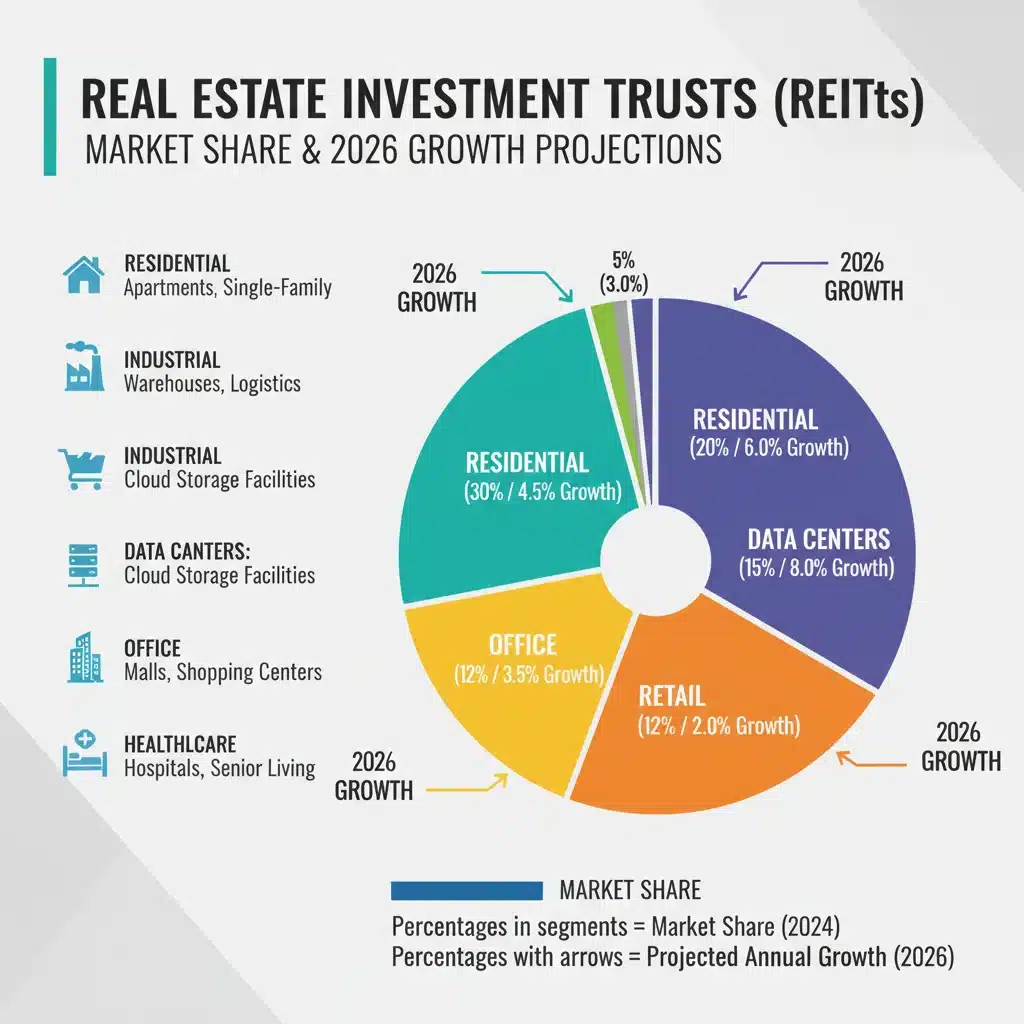
Industrial REITs, which own and manage warehouses, distribution centers, and logistics facilities, have been a stellar performer in recent years, largely due to the explosion of e-commerce. This trend is expected to continue well into 2026. The demand for efficient supply chains, last-mile delivery solutions, and cold storage facilities remains robust. Companies are continuously optimizing their logistics networks, driving strong occupancy rates and rent growth for industrial properties.
Investors in US REITs 2026 should look for industrial REITs with portfolios concentrated in key logistics hubs, near major transportation arteries, and with exposure to automation-friendly facilities. The shift towards reshoring and diversification of supply chains could also provide additional impetus for this sector.
Data Center REITs: Fueling the Digital Economy
The digital transformation continues unabated, driven by cloud computing, artificial intelligence, 5G deployment, and the Internet of Things (IoT). Data center REITs, which provide the specialized infrastructure to house critical computing equipment, are direct beneficiaries of these trends. The demand for secure, high-connectivity data storage and processing capabilities is exploding and shows no signs of slowing down.
For US REITs 2026, data center REITs offer exposure to a high-growth, technology-driven segment of the real estate market. Key considerations for investors include the REIT’s geographical footprint (proximity to major internet exchanges), customer base (hyperscalers vs. enterprises), and power efficiency of their facilities. The capital expenditure required for these specialized assets can be significant, but so too can the long-term, stable revenues.
Residential REITs: Adapting to Demographic Shifts
Residential REITs, encompassing apartments, single-family rentals (SFRs), and manufactured housing, are influenced by demographic trends, household formation, and affordability. As housing affordability remains a challenge in many major metropolitan areas, the demand for rental properties is likely to stay strong.
In US REITs 2026, SFR REITs are particularly interesting, as they cater to families seeking more space and a suburban lifestyle without the commitment of homeownership. Manufactured housing communities also offer an affordable alternative. Investors should analyze residential REITs based on their exposure to growing sunbelt markets, their ability to manage operating costs, and their focus on tenant satisfaction to ensure high retention rates.
Healthcare REITs: An Aging Population’s Needs
The aging demographic in the US continues to drive demand for healthcare services and facilities. Healthcare REITs own properties such as hospitals, medical office buildings, skilled nursing facilities, and senior living communities. This sector tends to be more resilient to economic downturns due to the non-discretionary nature of healthcare.
For US REITs 2026, the focus will be on REITs with strong operator partnerships, diversified portfolios across different healthcare sub-sectors, and properties in growing population centers. The long-term leases characteristic of many healthcare properties can provide stable income streams, though regulatory changes and operator risks need careful evaluation.
Specialty REITs: Niche Opportunities
Beyond the major categories, specialty REITs offer unique opportunities. These can include timberland, infrastructure (cell towers, fiber optic cables), casinos, and even farmland. These niche sectors often have specific drivers that can differentiate their performance from the broader real estate market.
For US REITs 2026, infrastructure REITs, particularly those focused on digital infrastructure like cell towers and fiber, are expected to continue their strong performance due to the ongoing rollout of 5G and increasing data consumption. Timberland REITs can offer a hedge against inflation and a sustainable investment theme. The key here is to understand the specific market dynamics and regulatory environment affecting each specialty sector.
Challenges and Risks for US REITs 2026
While opportunities abound, investors in US REITs 2026 must also be cognizant of potential challenges and risks that could impact returns.
Interest Rate Volatility
As discussed, interest rate fluctuations can significantly affect REIT valuations and profitability. Unexpected rate hikes could lead to increased financing costs and a re-evaluation of property cap rates, potentially putting downward pressure on REIT share prices.
Inflationary Pressures on Operating Costs
While rental income may rise with inflation, so too will operating expenses. If REITs cannot pass on these increased costs to tenants, or if leases have long fixed-rent periods, their net operating income could be squeezed. Labor costs, property taxes, and insurance premiums are all areas to monitor.
Geopolitical and Economic Uncertainty
Global geopolitical events, trade tensions, and unforeseen economic shocks can create volatility in financial markets, including real estate. A significant slowdown in global economic growth or a recession in the US could reduce demand for commercial and residential properties, impacting occupancy rates and rental growth for US REITs 2026.
Sector-Specific Headwinds
- Office REITs: The long-term impact of remote and hybrid work models continues to be a significant headwind. While some companies are calling employees back to the office, the overall demand for traditional office space may remain subdued, leading to higher vacancies and weaker rent growth, especially for older, less amenitized buildings.
- Retail REITs: While resilient, retail REITs still face competition from e-commerce. The success of retail REITs in 2026 will depend on their ability to adapt by creating experiential retail spaces, integrating omnichannel strategies, and attracting high-performing tenants.
Strategic Considerations for Investing in US REITs 2026
To successfully navigate the US REITs 2026 landscape, investors should adopt a strategic approach that emphasizes due diligence, diversification, and a long-term perspective.
Diversification Across Sectors and Geographies
Rather than concentrating investments in a single REIT sector, diversify across several promising areas like industrial, data centers, and residential. This approach helps mitigate risks associated with sector-specific downturns. Furthermore, consider geographical diversification within the US, favoring regions with strong population growth, job creation, and favorable business climates.
Focus on Strong Balance Sheets and Management Teams
In an environment of potential interest rate volatility, REITs with strong balance sheets, manageable debt levels, and ample liquidity will be better positioned to weather economic shifts. Evaluate the management team’s track record, their strategic vision, and their ability to adapt to changing market conditions. Transparent communication and a clear capital allocation strategy are also crucial.
Evaluate Dividend Sustainability and Growth
REITs are known for their attractive dividend yields, a requirement stemming from their mandate to distribute at least 90% of their taxable income to shareholders. When considering US REITs 2026, look beyond just the current yield. Assess the sustainability of the dividend by examining the REIT’s funds from operations (FFO) or adjusted funds from operations (AFFO) payout ratios. A growing dividend is a strong indicator of a healthy and expanding business.
Consider Active vs. Passive Investment Strategies
Investors can gain exposure to REITs through actively managed funds, passively managed ETFs, or by directly investing in individual REIT stocks. Actively managed funds may attempt to outperform the market by selecting specific REITs and sectors, while passive ETFs offer broad market exposure at a lower cost. The choice depends on an investor’s risk tolerance, investment goals, and desire for active management.
Leveraging Technology and ESG Factors
Technology continues to reshape the real estate industry. REITs that embrace proptech solutions for property management, tenant experience, and operational efficiency are likely to gain a competitive edge. Furthermore, Environmental, Social, and Governance (ESG) factors are becoming increasingly important. REITs with strong ESG practices can attract a broader investor base, potentially leading to better valuations and long-term sustainability. This is a growing area of interest for US REITs 2026.
Conclusion: Positioning for Success with US REITs 2026
The landscape for US REITs 2026 presents a dynamic mix of opportunities and challenges. While traditional sectors like office and some retail may continue to face headwinds, secular trends in e-commerce, digital transformation, and demographics are creating robust demand for industrial, data center, residential, and healthcare properties. Investors who conduct thorough due diligence, diversify their portfolios, and remain attuned to macroeconomic shifts will be best positioned to identify and capitalize on these opportunities.
Successful investing in REITs in the coming years will require a nuanced understanding of sector-specific drivers, a keen eye on interest rate and inflation trajectories, and an appreciation for the importance of strong management and sustainable business practices. By adopting a forward-looking and adaptable strategy, investors can unlock the significant potential offered by the evolving US real estate market through well-chosen REIT investments.
Remember, the information provided here is for general guidance and educational purposes. Always consult with a qualified financial advisor before making any investment decisions, as individual circumstances and market conditions can vary.