The Informational Advantage: How News Literacy Fuels Financial Empowerment
Anúncios
We treat the daily news and our personal finances as if they exist in separate universes. One is a stream of global events, political shifts, and market reports; the other is the quiet reality of our bank accounts, budgets, and retirement goals. But what if the wall between these two worlds is an illusion? The failure to connect the information we consume with the financial decisions we make represents one of the most significant, yet commonly overlooked, gaps in personal economic strategy.
This connection forms the basis of the “informational advantage.” It’s the ability to see a headline about a central bank’s interest rate decision and understand its direct impact on your mortgage payment or savings account yield. It’s not about becoming a Wall Street analyst but about developing the critical thinking skills to filter media noise, identify underlying trends, and recognize how macroeconomic forces shape your personal financial landscape. This literacy transforms passive news consumption into an active tool for wealth protection and growth.
Anúncios
This guide demystifies that process. We will explore how to critically decode financial news, separating journalistic spin from primary data. Then, we’ll outline the core competencies required to build a reliable financial IQ, from budgeting fundamentals to understanding investment vehicles. Finally, and most importantly, we will demonstrate how to translate this powerful combination of knowledge and insight into tangible financial benefits, empowering you to navigate the economy with greater confidence and control.
Understanding the Ecosystem: News, Education, and the Economy
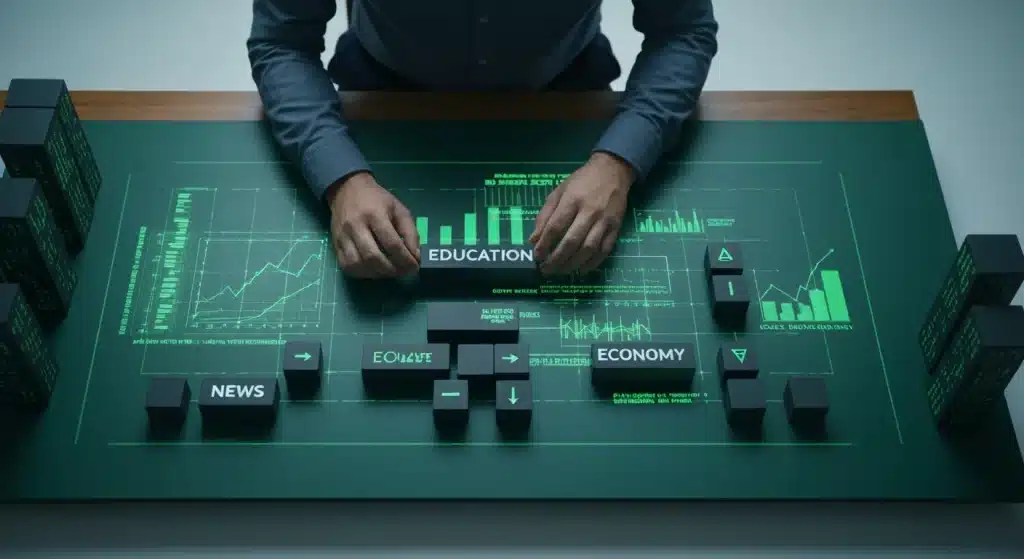
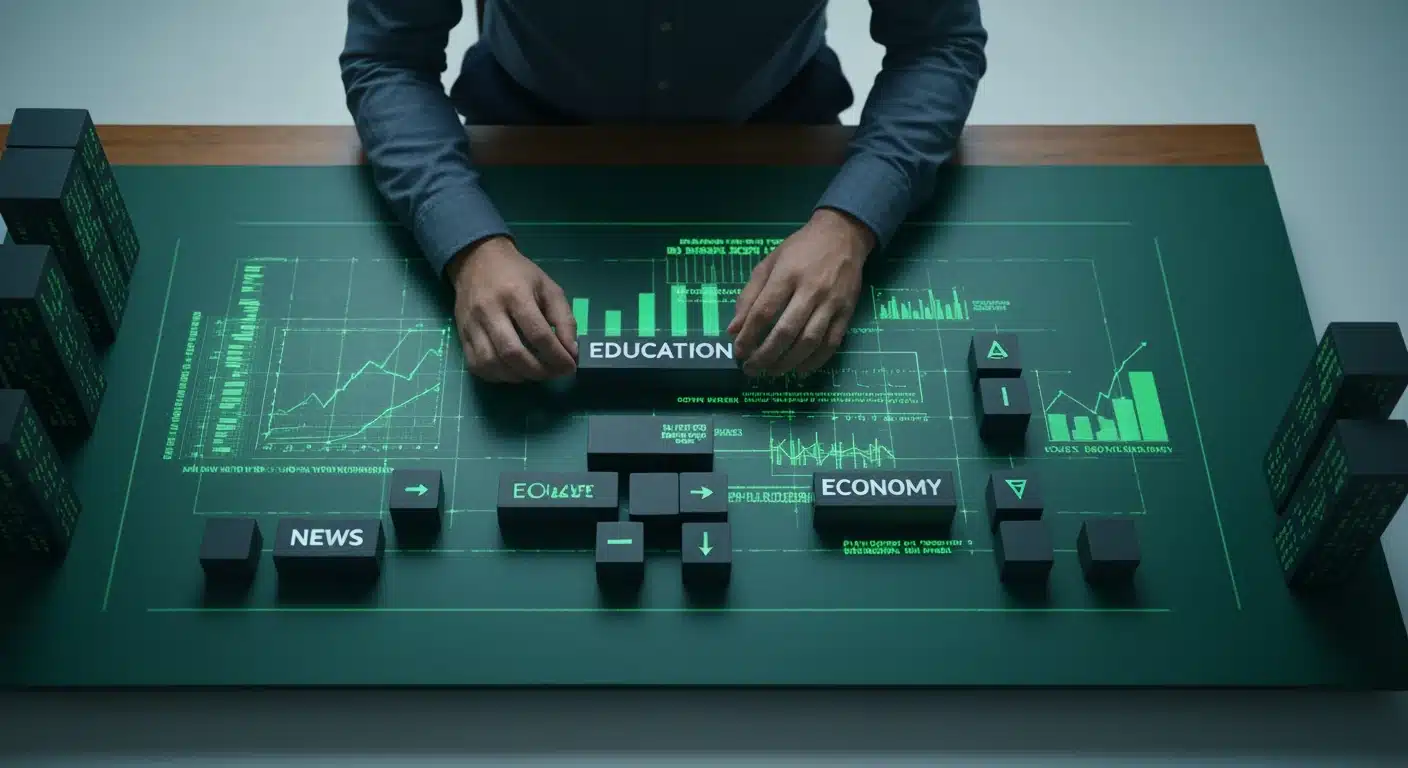
Most of us treat the daily news and our personal finances as completely separate streams of information. One is about what’s happening in the world, and the other is about what’s happening in our wallet. The underrated factor here is how deeply these two streams merge. The quality of information we consume directly shapes our educational foundation, which in turn governs our economic decisions and overall financial well-being. This is the core of the modern nexus of news, education, and finance.
Think of it like trying to cook a complex recipe. Your level of financial literacy is your culinary skill, learned through education and practice. The daily news—reporting on interest rate changes, market fluctuations, and new regulations—is like getting real-time updates on ingredient prices and availability. How can you successfully make the meal (manage your finances) if you don’t understand the recipe or the changing costs of your ingredients?
Anúncios
This isn’t just a theoretical link. A landmark study from the U.S. Financial Industry Regulatory Authority (FINRA) found that individuals who demonstrated higher financial literacy were significantly more likely to engage in beneficial financial behaviors. For instance, they were 34% more likely to have a non-retirement investment account. They simply make better choices.
What this data suggests is that staying informed is not a passive activity; it is an active strategy for financial empowerment. By understanding how economic events reported in the news affect your personal situation (—a skill sharpened by education—), you gain an advantage. You can anticipate challenges and spot opportunities before they become obvious to everyone else.
Ultimately, a commitment to consuming quality news and pursuing financial education is not just about being “in the know.” It’s about building a framework for making smarter, more confident decisions that directly impact your ability to navigate the financial landscape and secure your future. The informational advantage is real, and it’s available to anyone willing to pay attention.
Decoding Financial News: From Headlines to Real-World Impact
Reading financial news can often feel like trying to drink from a firehose. A constant stream of market predictions, corporate earnings reports, and economic forecasts floods our screens, each piece vying for attention with bold claims. The challenge isn’t just keeping up; it’s learning to separate the signal from the deafening noise. Many headlines are designed for clicks, not for clarity, which can lead to misguided financial decisions.
This is where critical analysis becomes your most valuable asset. It’s the difference between reacting to a sensationalist headline about a market crash and understanding the underlying data that prompted the report. The underrated factor here is recognizing that not all financial news is created equal. Some is investigative journalism, while much of it is closer to speculative opinion.
Identifying Bias and Spin in Economic Reporting
Bias in financial reporting often isn’t malicious; it’s simply a byproduct of the need to create a compelling story. A reporter might focus on the most dramatic data point in a government release or quote an analyst with a particularly bold—and often bearish—prediction. This creates a narrative that might not reflect the full, more nuanced reality. For instance, a report might scream “Inflation Soars!” while burying the fact that the 0.4% month-over-month increase was exactly what economists had predicted.
So, how do you spot this spin? A key tactic is to always question the source and its motivation. Is the outlet known for sensationalism or for measured analysis? A study from the University of Chicago’s Booth School of Business revealed that articles using emotionally charged language in their headlines see 23% more engagement but often have less predictive accuracy. Learning to filter this content is a core part of how news and education shape investment benefits. It’s like checking the ingredients on a food label instead of just trusting the flashy packaging.
Always cross-reference claims with primary sources whenever possible. If a news story cites a report from the Bureau of Labor Statistics, take five minutes to find the actual report. You might be surprised at how different the summary data looks without the layer of journalistic interpretation—and let’s be honest, you don’t need to read the whole thing, just the official summary.
Key Economic Indicators and Their News Context
Beyond identifying bias, a financially literate individual must understand the key metrics that reporters discuss. These indicators are the vital signs of an economy, but their meaning can be easily distorted. A solid grasp of what they represent is core to unpacking the modern benefits of financial literacy.
Here are a few common indicators and what to watch for in the news:
- Gross Domestic Product (GDP): This measures the total value of all goods and services produced by a country. News reports often focus on the percentage change from the previous quarter. A positive number indicates growth, but pay attention to the magnitude. A 0.5% growth rate is far different from a 3.5% one, though both might be reported simply as “economic expansion.”
- Consumer Price Index (CPI): As the most common measure of inflation, CPI tracks the average change in prices paid by urban consumers for a basket of goods and services. The key is to look beyond the headline number. Is the inflation “core” (excluding volatile food and energy prices) or broad-based? Understanding this distinction separates a temporary price shock from a persistent trend.
- Unemployment Rate: This seems straightforward, but the devil is in the details. The headline rate (known as U-3) only includes people without jobs who have actively looked for work recently. A more full measure, U-6, includes “discouraged workers” and the underemployed, which often tells a more complete story of the labor market’s health.
Simply knowing these terms isn’t enough. The real skill lies in contextualizing the data. A rising CPI might sound alarming, but if it follows a period of deflation and is coupled with strong wage growth, it could actually be a sign of a healthy, recovering economy. The narrative depends entirely on which data points the reporter chooses to highlight.
An investment in knowledge pays the best interest.
— Benjamin Franklin
| Concept | Core Principle |
|---|---|
| News Literacy | The ability to critically analyze financial news, distinguishing between factual reporting, speculation, and sensationalism to understand its real-world impact. |
| Financial Education | Building a foundational knowledge of core economic concepts, such as budgeting, debt management, and investment vehicles, to create a framework for sound decision-making. |
| The Informational Advantage | Applying news literacy and financial education together to proactively manage investments, mitigate risks, and identify long-term opportunities before they become mainstream. |
The Educational Imperative: Building a strong Financial IQ
Critically analyzing financial news is a necessary skill, but it’s only one side of the coin. Without a foundational understanding of the concepts being discussed, even the most data-driven report can feel like a foreign language. Building financial literacy isn’t about becoming a Wall Street analyst overnight; it’s about constructing a personal framework for making informed decisions. This education provides the context needed to translate market headlines into meaningful action.
Financial knowledge acts as a filter, helping you separate genuine opportunity from speculative noise. It empowers you to ask the right questions and challenge assumptions, whether you’re reading a corporate earnings report or sitting across from a financial advisor. This is where true financial empowerment begins.
Formal vs. Informal Financial Learning Paths
Acquiring financial acumen generally follows two distinct paths. The formal route involves structured programs like university business degrees, professional certifications such as the Certified Financial Planner (CFP), or even high school personal finance classes. A recent study by Next Gen Personal Finance revealed that while a growing number of states require a personal finance course for high school graduation, over half still do not, leaving a significant educational gap. These formal paths offer a detailed, vetted curriculum but often require a substantial investment of time and money.
Conversely, the informal path is a self-directed journey through books, podcasts, reputable blogs, and online courses. This approach offers incredible flexibility and can be tailored to your specific interests at a fraction of the cost. The primary challenge here is curation—it’s like trying to cook a gourmet meal by grabbing random ingredients from the grocery store aisle. You need a reliable map. Building a personalized curriculum by understanding the nexus of news, education, and finance is a key first step to avoid getting lost in a sea of conflicting advice.
Core Competencies for Financial Independence
Regardless of the learning path you choose, a set of core competencies underpins all sound financial decision-making. Mastering these areas creates a stable base from which you can confidently manage your money and pursue long-term goals. They are the primary tools in your financial toolkit.
Budgeting and Debt Management
This is the bedrock of personal finance. A budget is simply a plan for your money, but its power lies in the clarity it provides about your cash flow. While frameworks like the 50/30/20 rule (50% for needs, 30% for wants, 20% for savings) are excellent starting points, the most effective budget is one you customize and consistently follow. It’s less about restriction and more about intentionality.
Understanding and managing debt is equally vital. High-interest debt, particularly from credit cards, can rapidly undermine financial progress. According to recent Experian data, the average credit card balance per person in the U.S. was $6,501. What most people miss is not the total amount, but the corrosive effect of the average interest rate, which often exceeds 20% APR. Effectively managing debt involves prioritizing high-interest accounts and developing a systematic repayment strategy.
Understanding Investment Vehicles
Once your financial defense is solid, you can focus on offense: investing. Gaining a working knowledge of primary investment vehicles is non-negotiable for building wealth. This means understanding the basic differences between stocks (ownership in a company), bonds (a loan to an entity), mutual funds (a basket of stocks and/or bonds), and exchange-traded funds (ETFs), which trade like stocks but hold a collection of assets.
Each vehicle carries a different risk-reward profile. The key is to align your investment choices with your personal risk tolerance and time horizon—a concept necessary for anyone navigating the financial landscape effectively. A 25-year-old saving for retirement has a different strategy than a 60-year-old preparing to live off their investments. It’s not about picking “winners,” but about building a diversified portfolio that works for you.
Leveraging Digital Resources for Continuous Education
Financial markets and products are constantly changing, which makes lifelong learning a necessity. Fortunately, the digital age has democratized access to high-quality financial education. Reputable platforms like Coursera and edX offer courses from top universities, while government sites like the SEC’s Investor.gov provide unbiased, foundational information for free.
But with so many options, where do you begin? A good strategy is to combine broad learning with deep dives into specific topics. You might listen to a daily market analysis podcast during your commute while setting aside time on the weekend to learn a specific skill. Learning to use a stock screener or a retirement calculator—tools that were once the exclusive domain of professional advisors—is now a manageable weekend project. This habit of continuous, targeted learning ensures your financial IQ doesn’t just grow; it adapts.
Translating Knowledge into Tangible Financial Benefits
Moving from theory to practice is where financial education shows its value. The concepts learned in a book or a webinar are not just academic exercises; they are tools designed to build and protect wealth. The data suggests a direct link: a study from the TIAA Institute found that individuals displaying higher levels of financial literacy accumulated significantly more retirement wealth than their peers. This isn’t an accident. It’s a result of applying knowledge consistently.
Think of it like learning the rules of chess. You can’t expect to win if you don’t understand how the pieces move. Financial markets, while far more complex, operate on a similar principle where informed participants generally have better outcomes. The real question is, how does this knowledge specifically translate into dollars and cents?
Optimizing Investment Portfolios with Market Insights
One of the most direct applications of news literacy is in the construction and management of an investment portfolio. Consuming targeted financial news—from corporate earnings reports to analyses of central bank policy—allows you to make proactive adjustments rather than reactive mistakes. An investor following shifts in global trade policy, for instance, might reallocate assets away from industries heavily reliant on international supply chains long before any negative impact is reflected in stock prices.
This is where understanding the deep connection between news and investment benefits becomes a real advantage. An individual who reads about a breakthrough in battery technology might see a long-term opportunity in electric vehicle suppliers or raw material producers. This isn’t about timing the market perfectly, which is nearly impossible. It’s about identifying powerful trends and positioning your portfolio to benefit from them over time.
It’s a bit like using a traffic app on your commute; you get advanced warning of a slowdown ahead, giving you the chance to take a different route. According to research from FINRA, investors who regularly engage with financial news are over 30% more likely to re-evaluate their portfolios quarterly. That simple habit prevents strategic drift and ensures your investments stay aligned with your goals.
Mitigating Financial Risks Through Proactive Learning
Beyond seeking gains, a solid financial education is your best defense against catastrophic losses. Understanding the mechanics of different asset classes helps you appreciate the risks you are taking. This proactive learning shifts your mindset from simply chasing returns to building a resilient financial structure.
It’s about knowing what you own and why you own it.
“Strategic financial planning is less about predicting the future and more about building a structure that can withstand unforeseen shocks,” explains Dr. Amelia Vance, a behavioral economist at the University of Chicago. She points out that educated investors can better distinguish between temporary market volatility and a permanent impairment of their capital — a critical distinction that prevents panic-selling at the worst possible moment.
For example, someone with a basic grasp of interest rate dynamics would have understood the risks posed to long-duration bonds as monetary policy began to tighten. This knowledge could have prompted a shift into shorter-term assets or alternative investments designed to hedge against inflation. What most people miss is that the clues are often available, just buried in economic reports and policy statements. The entire process is a core part of the modern relationship between news, education, and finance.
Ultimately, the ability to filter valuable signals from the constant noise of the news cycle is the skill that pays dividends, protecting your financial well-being against uncertainty.
Future-Proofing Your Finances: Adapting to Evolving Economic Narratives
Thinking your financial plan is a “set it and forget it” affair is like pointing your car in the right direction and then closing your eyes. The economic road is full of unexpected curves, detours, and changing speed limits. Financial resilience in the modern era isn’t about having a perfect map; it’s about being an alert driver, ready to adapt to new information. This means continuous learning is no longer optional.
Emerging trends, from artificial intelligence reshaping industries to shifts in global trade policies, constantly rewrite the rules. A recent analysis by the Brookings Institution found that jobs with high exposure to new technologies could see significant wage and skill requirement changes. What does this mean for your wallet? It means the job that provides your income today might require a totally different skill set tomorrow. Ignoring these shifts is a direct risk to your long-term stability.
Consider the case of a small business owner who ran a local print shop. Seeing the rapid decline in print advertising, she didn’t just watch her revenue shrink. Instead, by following tech and marketing news, she pivoted her business toward specialized digital design services and local SEO consulting for other small businesses. This adaptation—a direct result of staying informed—is a powerful example of how news and education shape investment benefits, turning a potential crisis into a new revenue stream.
Building this adaptability doesn’t require a Ph.D. in economics.
Start by dedicating 20 minutes each day to credible financial news sources outside your usual bubble. Set up alerts for keywords related to your career field and major investments. The underrated factor here is consistency. This small daily habit forms the foundation of what many now consider the necessary nexus of news and finance. It’s about building an informational advantage—one small piece at a time.
Ultimately, the goal isn’t to become a fortune-teller who can perfectly predict the next market crash or tech boom. It’s about developing the financial muscle memory to react intelligently to change, ensuring that whatever the future economic narrative holds, you’re prepared to write your own successful chapter within it.
Your Next Move: From Information to Action
Viewing financial literacy not as a finite goal but as a continuous practice—much like physical fitness—reframes the entire journey. The objective isn’t to learn everything at once, but to build a sustainable habit of informed curiosity. The global economy is a dynamic entity, and the skills required to navigate it must be just as adaptive. The true informational advantage doesn’t come from a single, brilliant insight but from the cumulative effect of consistently paying attention.
So, what is the single most effective step you can take right now? Don’t try to read a complex analyst report. Instead, pick one financial metric you saw in this article—like the Consumer Price Index (CPI)—and set a reminder to look up its next official release. When the news breaks, read the primary summary from the source, like the Bureau of Labor Statistics, before you read any news articles about it. This small act of consulting the source first is the foundational habit from which all financial clarity grows.
Frequently Asked Questions
How does financial literacy directly impact personal wealth accumulation?
Financial literacy directly enables smarter decision-making regarding budgeting, debt, and investing. It equips individuals to avoid costly mistakes, like high-interest debt, and identify growth opportunities, leading to more effective compounding of wealth over a lifetime.
What are the most common misconceptions about financial news reporting?
A primary misconception is that all financial news is predictive investment advice. In reality, many headlines are designed for clicks and oversimplify complex data, which can encourage reactive, emotional decisions rather than strategic, informed ones.
Can financial education protect against economic downturns?
While it cannot prevent downturns, financial education provides the required tools to navigate them effectively. An educated individual is more likely to have a diversified portfolio, avoid panic selling, and understand how to position themselves for the eventual recovery.
Where can I find unbiased and reliable financial news sources?
Prioritize primary sources like government agencies (e.g., Bureau of Labor Statistics, SEC) and non-profit organizations. For journalism, look to established outlets with a history of in-depth analysis, and always make a habit of cross-referencing information to get a fuller picture.
What role does technology play in accessible financial education today?
Technology has been a turning point, democratizing access to financial knowledge through online courses, podcasts, educational apps, and data tools. It allows for personalized, on-demand learning, making it more convenient than ever to build and maintain financial literacy at any stage of life.