
Maximizing Your 2026 Social Security Benefits: Insider Strategies to Increase Your Payout by Up to 8%
For millions of Americans, Social Security represents a cornerstone of their retirement income. As we look towards 2026, understanding the nuances of this vital program can mean the difference between a comfortable retirement and one filled with financial anxieties. The decisions you make today, particularly regarding when and how you claim your benefits, can significantly impact your lifetime payout. In fact, by employing strategic planning, you could increase your monthly benefit by up to 8% for each year you delay claiming past your Full Retirement Age (FRA) up to age 70. This comprehensive guide will delve into insider strategies to help you maximize social security benefits for 2026, ensuring you receive every dollar you’re entitled to.
Anúncios
Understanding Your Full Retirement Age (FRA)
Before diving into strategies to maximize social security, it’s crucial to understand your Full Retirement Age (FRA). Your FRA is the age at which you are entitled to 100% of your Social Security primary insurance amount (PIA). This age varies depending on your birth year:
Knowing your FRA is the foundational step because it dictates how much your benefits will be reduced if you claim early, or increased if you claim late. Claiming before your FRA results in a permanent reduction, while delaying past your FRA up to age 70 results in significant increases.
The Power of Delayed Claiming: Up to 8% Annual Increase
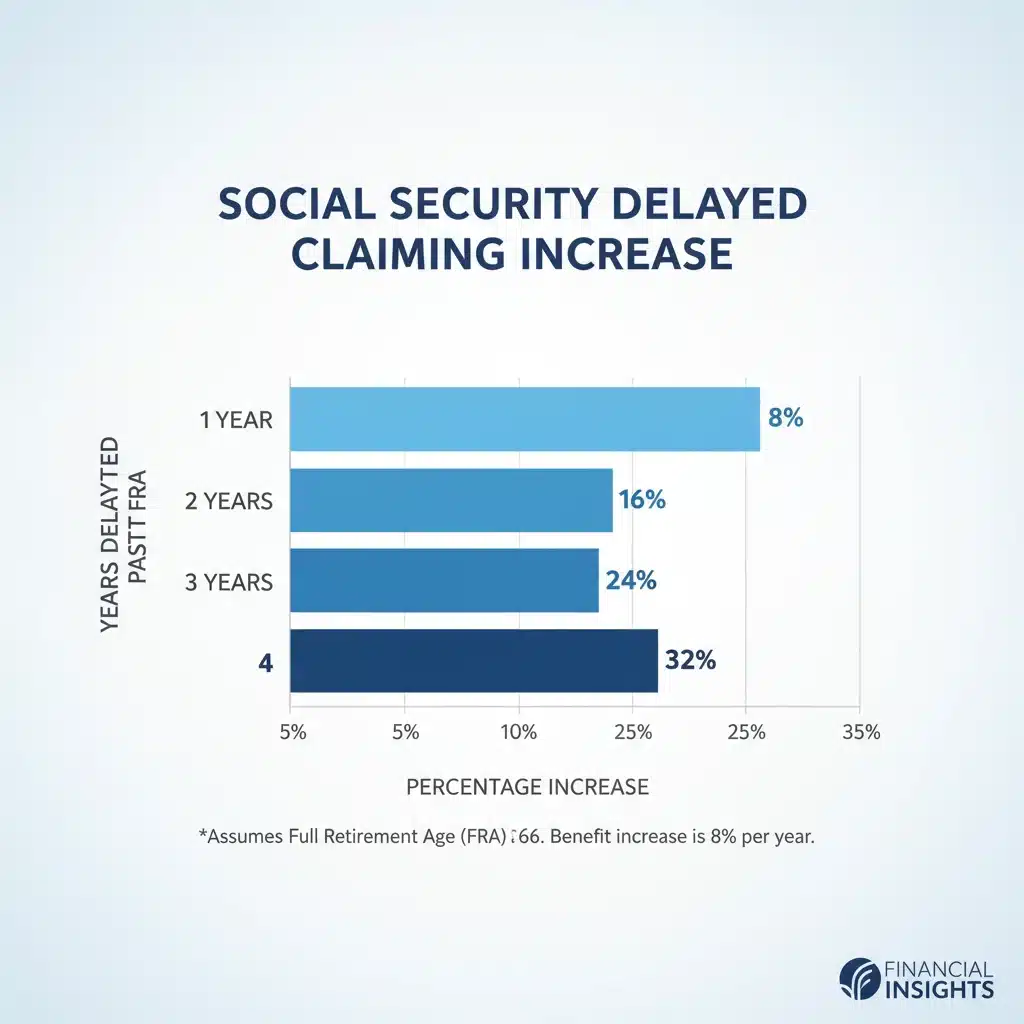
One of the most powerful strategies to maximize social security is delaying your claim beyond your Full Retirement Age. For every year you delay claiming Social Security benefits past your FRA, up to age 70, your benefits increase by a certain percentage. This is known as Delayed Retirement Credits (DRCs).
Anúncios
The annual increase is 8% for those born in 1943 or later. This means if your FRA is 67, and you wait until age 70 to claim, your monthly benefit will be 24% higher than it would have been at your FRA (3 years x 8% per year). This is a guaranteed, inflation-adjusted increase that can significantly boost your retirement income for the rest of your life. For many, this represents one of the best returns on investment available, especially in a volatile market environment.
Consider this: if your benefit at FRA (age 67) is $2,000 per month, delaying until age 70 would increase that to $2,480 per month ($2,000 * 1.24). Over a typical retirement lifespan, this difference can amount to hundreds of thousands of dollars.
When Does Delayed Claiming Make Sense?
While the 8% annual increase is compelling, delaying isn’t always the best strategy for everyone. Here are factors to consider:
- Health and Longevity: If you are in excellent health and have a family history of longevity, delaying makes a lot of sense. The longer you live, the more you benefit from the higher monthly payments. Conversely, if you have significant health issues, claiming earlier might be more prudent to ensure you receive benefits for a longer period.
- Current Income Needs: Do you need the income immediately? If you are still working or have sufficient retirement savings to cover your expenses until age 70, delaying is a strong option. If you are struggling financially, claiming earlier might be necessary, even with the reduction.
- Other Retirement Resources: Evaluate your 401(k), IRA, pensions, and other investments. If these resources are robust, they can bridge the gap, allowing you to delay Social Security and let it grow.
- Spousal Benefits: As we’ll discuss, claiming strategies can impact your spouse’s benefits, making it a joint decision.
Claiming Early: The Trade-Offs
You can start claiming Social Security benefits as early as age 62. However, claiming early comes with a significant and permanent reduction in your monthly benefit. The reduction is approximately 5/9 of 1% for each month before FRA, up to 36 months. If you claim more than 36 months early, the reduction is 5/12 of 1% per month. This can lead to a reduction of up to 30% if you claim at age 62 and your FRA is 67.
For example, if your FRA benefit is $2,000 and you claim at age 62 (5 years early), your benefit could be reduced to around $1,400 per month. While you receive payments for a longer period, the total lifetime payout might be less, especially if you live a long life. However, claiming early can be the right choice for some individuals:
- Poor Health: If you have a serious health condition and a shortened life expectancy, claiming early ensures you receive benefits for as long as possible.
- Immediate Financial Need: If you’ve lost your job, faced unexpected expenses, or simply cannot afford to wait, claiming early provides essential income.
- Spousal Strategy: In some cases, one spouse might claim early to allow the other spouse’s benefit to grow, as part of a coordinated strategy.
Coordinated Spousal Strategies to Maximize Social Security
For married couples, Social Security planning becomes more complex but also offers more opportunities to maximize social security benefits. There are specific rules regarding spousal benefits that can be leveraged. A spouse can claim benefits based on their own work record or up to 50% of their spouse’s Full Retirement Age benefit, whichever is higher. They cannot receive both.
Key Spousal Strategies:
- Higher Earner Delays, Lower Earner Claims Early/at FRA: Often, the higher-earning spouse delays claiming until age 70 to maximize their own benefit, which will also become the basis for the survivor benefit. The lower-earning spouse might claim their own benefit earlier, at FRA, or even at age 62, to provide some income during the delay period.
- “File and Suspend” (Grandfathered): While generally eliminated for new filers after April 29, 2016, if you were born on or before January 1, 1954, you might still be able to use a grandfathered “file and suspend” strategy. This allowed a person to file for their own benefits at FRA, immediately suspend them to earn Delayed Retirement Credits, and allow a spouse to claim spousal benefits based on their record. This is a highly specific scenario and requires careful verification with the SSA.
- Restricted Application for Spousal Benefits (Grandfathered): Similar to file and suspend, if you were born on or before January 1, 1954, and are at your FRA, you could file a “restricted application” to claim only spousal benefits while allowing your own benefits to continue growing until age 70. This allowed you to collect spousal benefits while accruing DRCs on your own record. Again, this is a grandfathered rule and applies only to a specific cohort.
- Survivor Benefits: If one spouse passes away, the surviving spouse can claim 100% of the deceased spouse’s benefit (if higher than their own benefit). This is why it’s often advisable for the higher earner to delay claiming, as their higher benefit will become the survivor benefit. A surviving spouse can claim survivor benefits as early as age 60 (or 50 if disabled) but benefits are reduced before their own FRA. They can also switch to their own higher benefit later if it grows larger.
Given the complexity of spousal strategies, especially with the changes to “file and suspend” and “restricted application” rules, it’s highly recommended to consult with a financial advisor specializing in Social Security to determine the optimal strategy for your unique situation.
The Impact of Working While Receiving Benefits
If you claim Social Security benefits before your Full Retirement Age and continue to work, your benefits may be reduced if your earnings exceed certain annual limits. This is known as the “earnings test.”
- Before FRA: For 2023 (limits are adjusted annually), if you are under FRA, the SSA will deduct $1 from your benefits for every $2 you earn above $21,240.
- In the Year You Reach FRA: In the year you reach your FRA, the SSA will deduct $1 from your benefits for every $3 you earn above a higher limit ($56,520 for 2023) until the month you reach FRA.
- At or After FRA: Once you reach your Full Retirement Age, the earnings test no longer applies. You can earn any amount of money without your Social Security benefits being reduced.
It’s important to note that any benefits withheld due to the earnings test are not lost forever. When you reach your FRA, your monthly benefit will be recalculated to give you credit for the months of benefits that were withheld. This means your future monthly payments will be slightly higher. However, it still impacts your immediate cash flow, so factor this into your decision to maximize social security.
Understanding Social Security Taxation
Many retirees are surprised to learn that their Social Security benefits can be subject to federal income tax. The amount taxed depends on your “combined income,” which is defined as your adjusted gross income (AGI) plus non-taxable interest plus one-half of your Social Security benefits.
- Individual Filers:
- If your combined income is between $25,000 and $34,000, up to 50% of your benefits may be taxable.
- If your combined income is above $34,000, up to 85% of your benefits may be taxable.
- Married Filing Jointly:
- If your combined income is between $32,000 and $44,000, up to 50% of your benefits may be taxable.
- If your combined income is above $44,000, up to 85% of your benefits may be taxable.
It’s crucial to consider this when planning your retirement income. Strategies to manage your AGI, such as Roth conversions in lower-income years before claiming Social Security, or strategically withdrawing from different types of accounts (taxable, tax-deferred, tax-free), can help reduce your combined income and potentially lower the tax bite on your benefits. State taxes on Social Security benefits also vary, with many states not taxing them at all, but some doing so.
Key Steps to Maximize Social Security for 2026
To effectively maximize social security benefits for 2026, a proactive and informed approach is essential. Here’s a roadmap:
1. Review Your Social Security Statement Annually
Your Social Security statement is a treasure trove of information. It provides an estimate of your future benefits at different claiming ages (62, FRA, and 70), your earnings record, and your estimated taxes paid. Review it carefully for any errors in your earnings history. Corrections can significantly impact your future benefits. You can access your statement online by creating an account at ssa.gov.
2. Understand Your Break-Even Point
The break-even point is the age at which the cumulative total of your higher delayed benefits surpasses the cumulative total of your earlier, smaller benefits. While helpful, it shouldn’t be the sole factor in your decision. Factors like health, other income, and spousal benefits should also weigh heavily. However, calculating this can provide a useful perspective on the financial implications of early vs. delayed claiming.
3. Coordinate with Your Spouse
As discussed, married couples have unique opportunities to optimize benefits. Work together to create a strategy that maximizes your combined lifetime benefits and provides adequate survivor protection. This often involves one spouse delaying benefits while the other claims strategically.
4. Consider All Sources of Retirement Income
Social Security is just one piece of your retirement puzzle. Integrate your Social Security claiming strategy with withdrawals from your 401(k), IRA, pensions, and other savings. For example, using funds from a Roth IRA to cover expenses in early retirement can allow you to delay Social Security and let it grow, without incurring additional taxable income that might affect your combined income threshold for Social Security taxation.
5. Seek Expert Advice
Social Security rules are complex and can change. A qualified financial advisor specializing in retirement planning can provide personalized guidance, help you run various scenarios, and ensure you’re making the most informed decisions to maximize social security benefits. They can also help you navigate the intricacies of spousal benefits, taxation, and integrating Social Security with your broader financial plan.

Common Misconceptions About Social Security
To truly maximize social security, it’s important to dispel some common myths:
- Myth: Social Security will run out. While the program faces long-term funding challenges, it is not projected to run out entirely. Current projections suggest it can pay about 80% of promised benefits if no legislative changes are made. It’s more likely that adjustments will be made to ensure its solvency, such as raising the full retirement age, increasing the taxable earnings cap, or slightly adjusting benefits.
- Myth: Claiming early is always bad. While it results in reduced benefits, claiming early can be the right choice for individuals with health issues, immediate financial needs, or as part of a coordinated spousal strategy.
- Myth: My benefits are not taxable. As detailed above, a significant portion of Social Security benefits can be subject to federal income tax, and in some states, state income tax.
- Myth: My spouse automatically gets my full benefit if I die. Not necessarily. A surviving spouse can receive 100% of the deceased spouse’s benefit only if they claim at their own FRA or later. If they claim earlier, the survivor benefit will be reduced.
- Myth: I can’t work and receive benefits. You can work and receive benefits, but if you are under your FRA, your benefits may be temporarily reduced if your earnings exceed certain limits. Once you reach FRA, there are no earnings limits.
Future Changes and Considerations for 2026 and Beyond
While this article focuses on current rules and strategies to maximize social security for 2026, it’s important to stay informed about potential future changes. Congress periodically debates adjustments to Social Security to ensure its long-term solvency. These could include:
- Adjustments to the Full Retirement Age: This has been a recurring topic of discussion.
- Changes to the Cost-of-Living Adjustment (COLA): The method for calculating COLA could be altered.
- Increases in the Social Security Taxable Earnings Cap: The maximum amount of earnings subject to Social Security taxes could be raised.
- Modifications to Benefit Formulas: Changes to how benefits are calculated for future retirees.
While it’s impossible to predict exact legislative outcomes, staying informed through reliable sources like the Social Security Administration’s website and reputable financial news outlets is prudent. These potential changes underscore the importance of flexible retirement planning and not relying solely on Social Security for your financial well-being.
Conclusion: Take Control of Your Social Security Future
Your Social Security benefits are a valuable asset, and strategic planning can significantly impact your financial security in retirement. By understanding your Full Retirement Age, evaluating the pros and cons of early versus delayed claiming, and exploring coordinated spousal strategies, you can take proactive steps to maximize social security benefits for 2026 and throughout your retirement. Don’t leave these crucial decisions to chance. Review your statements, educate yourself, and consider seeking professional guidance to ensure you’re making the best choices for your unique circumstances. The difference between an uninformed decision and a strategic one could be thousands of dollars in your pocket each year, providing a more secure and comfortable retirement.