Navigating 2026 Capital Gains Tax Changes: A U.S. Investor’s Guide

Anúncios
The financial landscape for investors in the United States is constantly evolving, and a significant shift is on the horizon with the anticipated 2026 Capital Gains Tax adjustments. For many, capital gains taxes represent a substantial portion of their investment returns. Understanding these impending changes and proactively planning for them is not just advisable; it’s essential for preserving wealth and optimizing your investment portfolio.
Anúncios
This comprehensive guide delves into the specifics of the expected 2026 Capital Gains Tax modifications, exploring their potential impact on various investment strategies and offering actionable insights to help you navigate this complex terrain. Whether you’re a seasoned investor or just starting, staying informed and adapting your approach will be key to financial success in the coming years.
Understanding Capital Gains Tax: A Foundation for 2026
Before we dive into the specifics of the 2026 Capital Gains Tax, it’s crucial to have a solid understanding of what capital gains tax entails. In the simplest terms, a capital gain is the profit you make from selling an asset that has increased in value. This can include stocks, bonds, real estate, and even certain collectibles. The Internal Revenue Service (IRS) taxes these gains, and the rate at which they are taxed depends on several factors, primarily the length of time you held the asset and your overall income level.
Short-Term vs. Long-Term Capital Gains
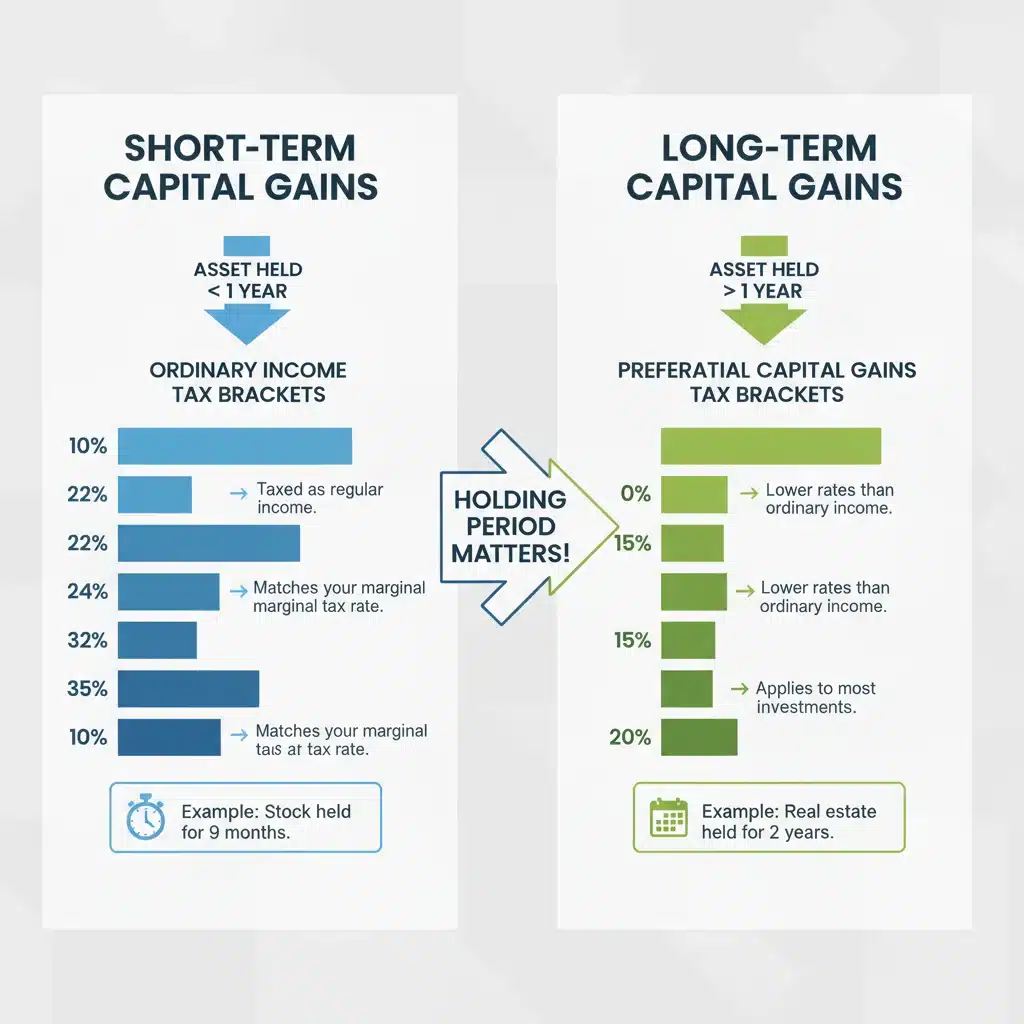
The distinction between short-term and long-term capital gains is fundamental. Short-term capital gains are realized from assets held for one year or less. These gains are typically taxed at your ordinary income tax rates, which can be as high as 37% for the top earners. Conversely, long-term capital gains are derived from assets held for more than one year. These are generally taxed at more favorable rates, typically 0%, 15%, or 20%, depending on your taxable income.
Anúncios
This differential treatment is a cornerstone of investment planning. Investors often aim for long-term holdings to benefit from these lower tax rates. The 2026 Capital Gains Tax adjustments are expected to potentially alter these rates or the income thresholds at which they apply, making this distinction even more critical.
The Role of Income in Capital Gains Taxation
Your adjusted gross income (AGI) plays a significant role in determining your capital gains tax rate. For instance, in current tax law, individuals with lower taxable incomes might qualify for a 0% long-term capital gains tax rate. As income rises, so does the capital gains tax rate. These income thresholds are subject to change, and the 2026 adjustments could redefine who qualifies for which rate, impacting a broad spectrum of U.S. investors.
Anticipated 2026 Capital Gains Tax Adjustments: What to Expect
While the precise details of the 2026 Capital Gains Tax adjustments are still subject to legislative processes and political negotiations, several key areas are widely discussed as potential targets for reform. These discussions are often driven by economic policy objectives, such as addressing income inequality, funding government programs, or stimulating specific sectors of the economy.
Potential Rate Increases
One of the most frequently discussed changes is an increase in the long-term capital gains tax rates. Some proposals have suggested aligning long-term capital gains rates more closely with ordinary income tax rates for high-income earners. This could mean that the current top long-term rate of 20% might rise, potentially impacting affluent investors and their portfolio strategies significantly. Such a change would reduce the tax advantage of holding assets for more than a year, prompting a re-evaluation of investment horizons and asset allocation.
Changes to Income Thresholds
Another area of potential adjustment involves the income thresholds that determine which capital gains tax rate applies. Even if the rates themselves don’t change drastically, lowering the income thresholds for higher rates could pull more investors into higher tax brackets for their capital gains. This would effectively increase the tax burden for a wider range of middle and upper-middle-class investors who might currently benefit from the 15% long-term capital gains rate.
Modifications to Step-Up in Basis
The ‘step-up in basis’ rule is a significant tax advantage for heirs. Under current law, when an inherited asset is sold, its cost basis is ‘stepped up’ to its market value on the date of the original owner’s death. This often allows heirs to avoid paying capital gains tax on the appreciation that occurred during the original owner’s lifetime. There have been discussions and proposals to modify or even eliminate the step-up in basis, particularly for very large estates. Any changes here would have profound implications for estate planning and intergenerational wealth transfer, making the 2026 Capital Gains Tax adjustments a critical factor for families with substantial inherited assets.
Impact on Specific Investment Vehicles
Certain investment vehicles, such as qualified opportunity funds or certain real estate investments, currently enjoy preferential tax treatment. The 2026 adjustments could also target these specific provisions, either by modifying their benefits or by introducing new regulations. Investors utilizing these vehicles would need to carefully assess the changes and adjust their strategies accordingly.
Strategic Planning for the 2026 Capital Gains Tax Adjustments
Given the potential for significant changes, proactive tax planning is paramount. Waiting until the last minute could lead to missed opportunities or unnecessary tax liabilities. Here are several strategies U.S. investors can consider to prepare for the 2026 Capital Gains Tax adjustments.
1. Harvest Gains and Losses Strategically
Tax-loss harvesting is a well-established strategy that involves selling investments at a loss to offset capital gains and, potentially, a limited amount of ordinary income. As we approach 2026, investors might consider accelerating capital gains into years with potentially lower tax rates, or conversely, deferring gains if rates are expected to decrease (though this is less likely in the current climate). The ability to strategically realize gains and losses before new legislation takes effect can significantly impact your overall tax burden.
Consider conducting a thorough review of your portfolio’s unrealized gains and losses. If you have substantial unrealized gains and anticipate higher capital gains tax rates in 2026, it might be prudent to realize some of those gains in 2024 or 2025, if doing so aligns with your financial goals and risk tolerance. This strategy, often referred to as ‘gain harvesting,’ allows you to lock in current, potentially lower, tax rates.
2. Reassess Your Investment Horizon and Asset Allocation
The distinction between short-term and long-term capital gains could become even more impactful. If the long-term capital gains rates for high-income earners increase significantly, investors might need to re-evaluate their investment horizons. A greater emphasis on holding assets for longer than one year could become even more financially advantageous. Review your current asset allocation to ensure it aligns with your long-term goals and the evolving tax landscape.
For those with a shorter investment horizon or a more active trading strategy, the potential increase in short-term capital gains tax rates (if they align more closely with ordinary income) could necessitate a shift in approach. This might involve reducing the frequency of trades or focusing on tax-efficient investment vehicles.
3. Utilize Tax-Advantaged Accounts
Tax-advantaged accounts, such as 401(k)s, IRAs (Traditional and Roth), and 529 plans, offer significant tax benefits that can help mitigate the impact of capital gains tax adjustments. Contributions to traditional 401(k)s and IRAs are often tax-deductible, and investments grow tax-deferred until withdrawal. Roth IRAs, while funded with after-tax dollars, allow for tax-free withdrawals in retirement. The growth within these accounts is shielded from annual capital gains taxes, making them powerful tools for long-term wealth accumulation, especially in a changing tax environment.
Maximizing contributions to these accounts should be a priority for many investors. Even if capital gains tax rates rise, the tax-deferred or tax-free growth within these vehicles provides a substantial advantage. For instance, if you anticipate being in a higher tax bracket in the future, a Roth conversion might be a strategy to consider before the 2026 Capital Gains Tax changes take effect, allowing you to pay taxes on the conversion at current rates.
4. Explore Tax-Efficient Investment Vehicles
Beyond traditional retirement accounts, other tax-efficient investment vehicles can help reduce your capital gains tax exposure. Municipal bonds, for example, often offer interest income that is exempt from federal income tax and sometimes state and local taxes, depending on where you live and where the bond was issued. Exchange-Traded Funds (ETFs) are generally more tax-efficient than actively managed mutual funds due to their structure, which often results in fewer capital gains distributions.
For real estate investors, strategies like 1031 exchanges (like-kind exchanges) allow you to defer capital gains taxes when you sell an investment property and reinvest the proceeds into a similar property. While these rules are complex and subject to specific requirements, they can be a powerful tool for deferring taxes on real estate appreciation. Staying informed about any potential changes to 1031 exchange rules under the 2026 Capital Gains Tax adjustments is crucial.
5. Consider Charitable Giving Strategies
For philanthropically inclined investors, donating appreciated assets directly to charity can be a highly tax-efficient strategy. When you donate appreciated stock or other property held for more than a year to a qualified charity, you generally don’t have to pay capital gains tax on the appreciation, and you can typically deduct the fair market value of the asset from your taxes (subject to certain limitations). This allows you to support causes you care about while simultaneously reducing your tax burden, a strategy that becomes even more appealing if capital gains tax rates are set to increase.
Strategies like donor-advised funds also offer flexibility in charitable giving while providing immediate tax benefits. These funds allow you to make an irrevocable contribution to a public charity that sponsors the fund, receiving an immediate tax deduction, and then recommend grants to your favorite charities over time.
6. Review Estate Planning Documents
As mentioned, potential changes to the step-up in basis rule could significantly impact estate planning. If these changes materialize, the tax implications for heirs inheriting appreciated assets could be substantial. It’s imperative to review your estate plan with an attorney and financial advisor to understand how potential 2026 Capital Gains Tax adjustments might affect your beneficiaries and to explore strategies to minimize future tax liabilities for your heirs. This might involve considering trusts, gifting strategies, or other estate planning tools.

7. Stay Informed and Seek Professional Advice
The legislative process is dynamic, and the final form of the 2026 Capital Gains Tax adjustments may differ from initial proposals. It is critical for investors to stay informed about legislative developments and to consult with qualified financial advisors and tax professionals. These experts can provide personalized advice tailored to your specific financial situation, investment goals, and risk tolerance. They can help you understand the nuances of the new tax laws and implement the most effective strategies to optimize your portfolio and minimize your tax burden.
A good financial advisor will not only help you navigate the immediate changes but also assist in developing a long-term financial plan that is resilient to future tax reforms and economic shifts. Regular reviews of your financial plan and tax strategy are essential, especially in periods of legislative uncertainty.
Potential Economic Impacts of 2026 Capital Gains Tax Changes
Beyond individual investor strategies, the 2026 Capital Gains Tax adjustments could have broader economic implications. Changes to capital gains taxation can influence investment behavior, capital formation, and market liquidity.
Impact on Investment Behavior
Higher capital gains taxes could disincentivize certain types of investments, particularly those with high growth potential that are typically held for shorter periods. This might lead to a shift towards more conservative investments or a greater emphasis on dividend-paying stocks and income-generating assets, which are taxed differently. Conversely, if the long-term capital gains rates remain relatively favorable, it could further encourage long-term holding periods, potentially reducing market volatility.
Capital Formation and Entrepreneurship
Some economists argue that increasing capital gains taxes can reduce the incentive for venture capital and angel investors to fund new, high-risk startups. If the potential returns are significantly reduced by higher taxes, it could lead to less capital flowing into innovative new businesses, potentially slowing economic growth and job creation. The design of the 2026 Capital Gains Tax adjustments will be crucial in determining this impact.
Market Liquidity
A significant increase in capital gains taxes could also lead to a ‘lock-in effect,’ where investors are reluctant to sell appreciated assets to avoid paying higher taxes. This can reduce market liquidity, making it harder for buyers and sellers to find each other and potentially leading to less efficient capital allocation. Policymakers will likely weigh these potential effects when finalizing any changes.
The Importance of Proactive Engagement
The period leading up to 2026 is a critical window for U.S. investors to review their financial strategies. It’s not just about reacting to new laws, but about proactively positioning your portfolio for success. This means understanding the current tax environment, anticipating potential changes, and working with professionals to implement a robust plan.
Consider the following steps:
- Educate Yourself: Continuously seek information from reputable sources about ongoing legislative discussions regarding the 2026 Capital Gains Tax.
- Analyze Your Portfolio: Understand your current unrealized gains and losses, and how different tax scenarios might affect them.
- Consult Experts: Engage with a financial advisor and a tax professional who can offer tailored advice and help you model different outcomes.
- Review Your Goals: Ensure your investment strategies remain aligned with your long-term financial objectives, even with potential tax changes.
Conclusion: Navigating the Future of Investment Taxation
The anticipated 2026 Capital Gains Tax adjustments present both challenges and opportunities for U.S. investors. While the specifics are still unfolding, the overarching message is clear: preparation is key. By understanding the fundamentals of capital gains taxation, staying informed about potential legislative changes, and implementing proactive strategies, you can mitigate potential tax liabilities and optimize your investment portfolio for continued growth.
The landscape of investment taxation is never static, but with careful planning and expert guidance, you can confidently navigate these changes and ensure your financial future remains secure. Don’t wait until the last moment; begin your assessment and planning today to be well-positioned for the tax environment of 2026 and beyond.