2026 COLA: Understanding Social Security’s 3.2% Adjustment and Its Impact

Anúncios
Understanding the intricacies of Social Security adjustments is paramount for current and future beneficiaries. As we look ahead, the projected 2026 COLA adjustment for Social Security stands at an estimated 3.2%. This figure, while still a projection, carries significant weight, influencing the financial stability and purchasing power of millions of Americans. This comprehensive guide will delve deep into what this adjustment means, how it’s calculated, its potential impact on your finances, and strategies to navigate the evolving economic landscape.
The Cost-of-Living Adjustment (COLA) is a critical mechanism designed to ensure that Social Security benefits retain their purchasing power in the face of inflation. Without COLA, the fixed income of retirees and other beneficiaries would steadily erode over time, making it increasingly difficult to cover essential living expenses. The 3.2% projection for 2026 offers a glimpse into the economic conditions anticipated for the coming years and provides a crucial benchmark for personal financial planning.
Anúncios
What is the 2026 COLA Adjustment and Why Does It Matter?
The 2026 COLA adjustment refers to the anticipated increase in Social Security benefits that will take effect in January 2026. This adjustment is not arbitrary; it’s a direct response to changes in the cost of living, specifically measured by the Consumer Price Index for Urban Wage Earners and Clerical Workers (CPI-W). The Social Security Administration (SSA) uses the average CPI-W for the third quarter (July, August, September) of the current year compared to the third quarter of the previous year to determine the COLA for the upcoming year.
A 3.2% increase, if finalized, would mean that for every $1,000 in monthly Social Security benefits, beneficiaries would receive an additional $32. While this might seem modest to some, for individuals and families relying heavily on Social Security as their primary income source, such an adjustment can be the difference between maintaining their standard of living and facing financial hardship. It impacts everything from grocery bills and utility costs to healthcare expenses and housing.
Anúncios
Understanding this adjustment matters for several key reasons:
- Preserving Purchasing Power: The primary goal of COLA is to protect beneficiaries from inflation. As the cost of goods and services rises, COLA ensures that benefits keep pace, allowing recipients to afford the same level of goods and services as before.
- Financial Planning: For retirees and those nearing retirement, knowing the projected COLA helps in accurately forecasting future income. This is crucial for budgeting, investment planning, and making informed decisions about retirement savings and withdrawals.
- Economic Indicator: The COLA also serves as an economic indicator, reflecting inflationary pressures within the economy. A higher COLA suggests a period of rising prices, while a lower or zero COLA indicates stable or falling prices.
- Impact on Other Benefits: While primarily associated with Social Security, COLA adjustments can indirectly influence other benefits or programs that are tied to income thresholds or cost-of-living metrics.
How is the 2026 COLA Adjustment Calculated? The CPI-W Connection
The calculation of the 2026 COLA adjustment is a precise process overseen by the Social Security Administration. It hinges entirely on the Consumer Price Index for Urban Wage Earners and Clerical Workers (CPI-W), which is published monthly by the Bureau of Labor Statistics (BLS). The CPI-W measures the average change over time in the prices paid by urban wage earners and clerical workers for a market basket of consumer goods and services.
Here’s a breakdown of the calculation process:
- Reference Periods: The SSA compares the average CPI-W for the third quarter (July, August, September) of the current year (2025 for the 2026 COLA) with the average CPI-W for the third quarter of the last year in which a COLA was payable.
- Percentage Increase: The percentage increase in the CPI-W from the base year’s third quarter to the current year’s third quarter determines the COLA. For instance, if the average CPI-W for Q3 2025 is 3.2% higher than the average CPI-W for Q3 2024 (assuming 2024 had a COLA), then the 2026 COLA would be 3.2%.
- Rounding: The calculated percentage is then rounded to the nearest one-tenth of one percent.
- Zero COLA: If there is no increase in the CPI-W, or if it decreases, there is no COLA for that year. Benefits would remain unchanged.
It’s important to note that the CPI-W differs from the more commonly cited CPI-U (Consumer Price Index for All Urban Consumers). The CPI-W focuses specifically on the spending habits of urban wage earners and clerical workers, a demographic that is considered more representative of Social Security beneficiaries. This distinction is crucial as the spending patterns and inflationary experiences of these groups can vary.
While the 3.2% is a projection, the final figure will be announced in October 2025, after the release of the September CPI-W data. Until then, financial analysts and economists use various models and current economic trends to estimate the likely COLA, providing valuable insights for future planning.
Anticipated Financial Impact of a 3.2% 2026 COLA Adjustment
A 3.2% 2026 COLA adjustment will have a tangible impact on the financial lives of over 70 million Americans, including retirees, disabled workers, and survivors. While the increase is designed to offset inflation, its real-world effect can vary depending on individual circumstances.
Increased Monthly Benefits
The most direct impact will be an increase in monthly Social Security checks. For example:
- If your current monthly benefit is $1,500, a 3.2% COLA would add $48, bringing your new benefit to $1,548.
- For a benefit of $2,000, the increase would be $64, resulting in a new benefit of $2,064.
- The maximum Social Security benefit for someone retiring at full retirement age (FRA) would also see a proportional increase, providing a higher ceiling for beneficiaries.
This increased income can help cover rising costs for everyday essentials, but it’s crucial to consider other factors that might offset these gains.
Medicare Part B Premiums
One of the most significant considerations for many Social Security beneficiaries is the potential impact on Medicare Part B premiums. By law, Medicare Part B premiums are typically deducted directly from Social Security benefits. While there’s a ‘hold harmless’ provision that prevents most beneficiaries from seeing a decrease in their net Social Security benefit due to a Part B premium increase, a substantial COLA can mean that a larger portion of the increase is absorbed by higher Medicare costs.
For those not covered by the ‘hold harmless’ provision (e.g., new enrollees, those paying higher income-related monthly adjustment amounts (IRMAA), or those whose Part B premiums are paid by Medicaid), the increase in Part B premiums could significantly diminish the net gain from the COLA.
Income Tax on Social Security Benefits
Another often-overlooked aspect is the taxation of Social Security benefits. If your combined income (adjusted gross income + non-taxable interest + one-half of your Social Security benefits) exceeds certain thresholds, a portion of your Social Security benefits may be subject to federal income tax. These thresholds are not indexed for inflation, meaning that even a modest COLA increase could push some beneficiaries into a higher tax bracket, or cause a larger percentage of their benefits to become taxable.
- For single filers, if your combined income is between $25,000 and $34,000, up to 50% of your benefits may be taxable. Above $34,000, up to 85% may be taxable.
- For married couples filing jointly, if your combined income is between $32,000 and $44,000, up to 50% of your benefits may be taxable. Above $44,000, up to 85% may be taxable.
A 3.2% COLA could mean that individuals who were just below these thresholds might find themselves subject to taxation, or those already paying taxes on their benefits might see a larger portion of their benefits taxed.
Impact on Other Means-Tested Programs
For individuals receiving other means-tested government benefits (e.g., Medicaid, Supplemental Security Income (SSI), food stamps, housing assistance), an increase in Social Security benefits due to the 2026 COLA adjustment could potentially affect their eligibility or the amount of assistance they receive. These programs often have strict income limits, and even a small increase in Social Security income could push beneficiaries over these thresholds, leading to a reduction or loss of other vital support.
Historical Context and Future Projections Beyond the 2026 COLA Adjustment
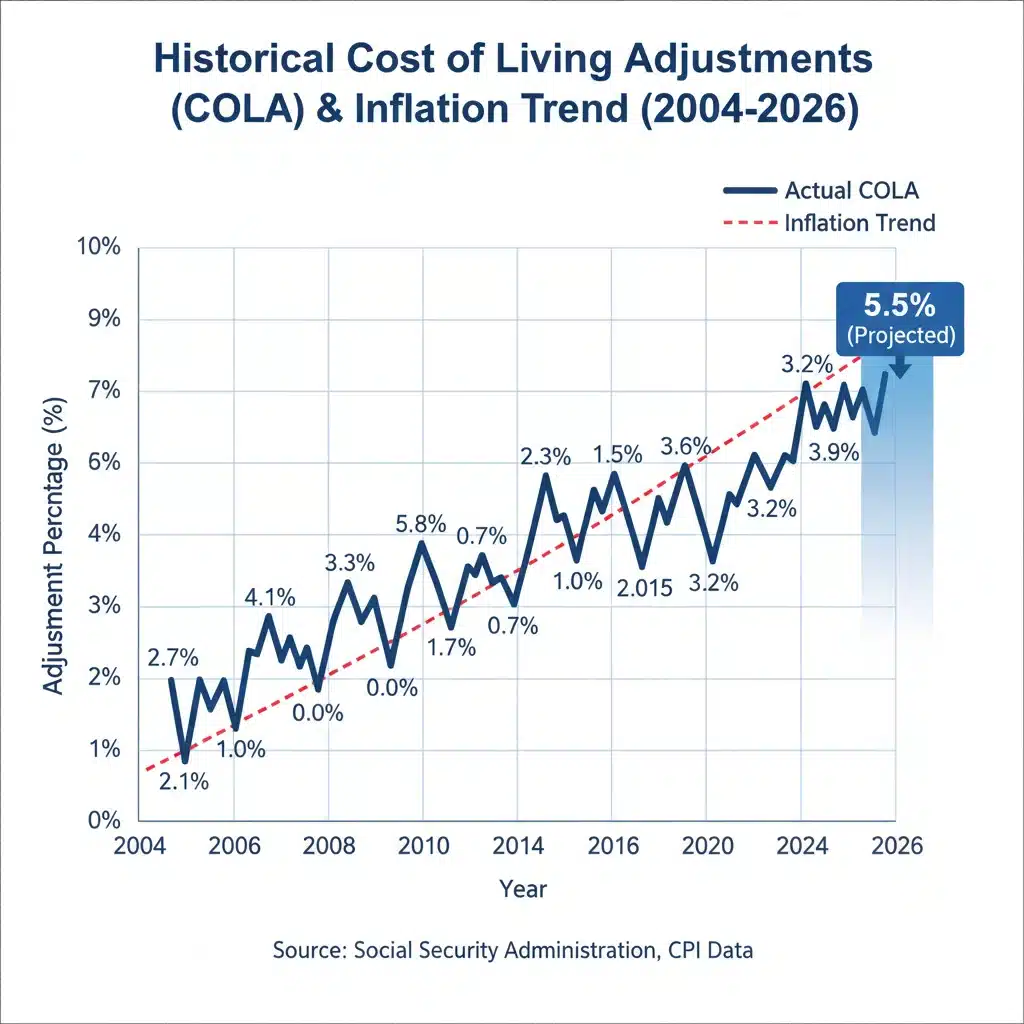
To fully appreciate the significance of the projected 2026 COLA adjustment, it’s helpful to examine it within a historical context. COLA adjustments have varied widely over the decades, reflecting different economic climates. In periods of high inflation, such as the late 1970s and early 1980s, COLA increases were in the double digits. Conversely, in periods of low inflation or deflation, there have been years with very small or even zero COLA adjustments.
Recent COLA Trends:
- 2022: 5.9% – A significant increase reflecting rising inflation post-pandemic.
- 2023: 8.7% – The largest COLA in over 40 years, driven by exceptionally high inflation.
- 2024: 3.2% – A substantial increase, though lower than the previous two years, indicating moderating inflation.
- 2025: (Projected) – Estimates vary, but many analysts anticipate a COLA in the range of 2-3%.
- 2026: (Projected) 3.2% – Reflects ongoing inflationary pressures, albeit potentially stabilizing.
The projected 3.2% for 2026 suggests that while the extreme inflationary pressures of 2022-2023 may be easing, inflation remains a persistent factor in the economy. This level of adjustment indicates that the cost of living is still rising at a notable pace, necessitating continued increases in benefits to maintain purchasing power.
Factors Influencing Future COLA Projections:
- Inflation Rates: The most direct driver. Ongoing global supply chain issues, energy prices, and wage growth will all play a role.
- Federal Reserve Policy: Interest rate decisions by the Federal Reserve influence inflation. Tighter monetary policy aims to cool the economy and reduce price pressures.
- Economic Growth: Strong economic growth can lead to higher demand and potentially higher inflation, impacting COLA.
- Geopolitical Events: Global events, such as conflicts or trade disputes, can disrupt supply chains and commodity markets, leading to inflationary spikes.
While the 2026 COLA adjustment is a projection, it provides a crucial data point for understanding the trajectory of inflation and its impact on Social Security benefits. Beneficiaries and financial planners should stay informed about these trends to make the most accurate long-term financial forecasts.
Strategies for Financial Planning with the 2026 COLA Adjustment
Given the projected 2026 COLA adjustment of 3.2%, it’s an opportune time for Social Security beneficiaries and those nearing retirement to review and adjust their financial plans. Proactive planning can help maximize the benefit of the COLA and mitigate any potential negative impacts.
1. Re-evaluate Your Budget
With an anticipated increase in Social Security income, revisit your monthly budget. Factor in the higher benefit amount, but also account for potential increases in expenses, especially Medicare Part B premiums and other healthcare costs. A detailed budget will help you understand where your money is going and identify areas for potential savings or reallocation.
- Track expenses: Use budgeting apps or spreadsheets to monitor spending.
- Anticipate cost increases: Don’t just consider the COLA increase; research expected increases in healthcare, housing, and food costs.
- Adjust discretionary spending: Determine if your increased income allows for more discretionary spending or if it’s primarily absorbed by essential costs.
2. Understand Medicare Part B Premium Implications
As discussed, Medicare Part B premiums can significantly offset COLA gains. Stay informed about the projected Medicare Part B premiums for 2026, which are typically announced in the fall of 2025. If you’re subject to IRMAA, understand how your income (including the COLA increase) might affect your premium tiers. Consider consulting with a financial advisor or Medicare specialist to understand your specific situation.
3. Plan for Potential Tax Implications
If your combined income is close to or exceeds the Social Security taxation thresholds, a 3.2% COLA could push more of your benefits into the taxable range. Strategies to consider include:
- Tax-efficient withdrawals: If you have diversified retirement accounts (e.g., Roth IRAs, traditional IRAs, taxable brokerage accounts), strategize your withdrawals to manage your adjusted gross income.
- Qualified Charitable Distributions (QCDs): If you’re over 70.5, QCDs from an IRA can satisfy RMDs and reduce your taxable income.
- Consult a tax professional: A tax advisor can provide personalized guidance on minimizing your tax liability.
4. Review Your Investment Strategy
While Social Security provides a foundational income, many retirees also rely on investments. Consider how persistent inflation, reflected in the 2026 COLA adjustment, might impact your portfolio. Are your investments adequately diversified to protect against inflation? Do you have enough liquidity to cover unexpected expenses?
- Inflation-protected securities: Consider Treasury Inflation-Protected Securities (TIPS) or other inflation-hedging assets.
- Dividend stocks and real estate: These can offer income streams that may keep pace with inflation.
- Rebalance your portfolio: Ensure your asset allocation aligns with your risk tolerance and financial goals, especially in an inflationary environment.
5. Consider Future Work or Part-Time Employment
For some, the COLA increase may not be sufficient to cover all rising costs. If feasible and desired, consider part-time employment or consulting work. This can supplement your income, provide intellectual stimulation, and potentially delay drawing down other retirement assets.
6. Stay Informed and Adapt
Economic conditions are dynamic. Stay updated on official announcements regarding the 2026 COLA adjustment and subsequent years. Be prepared to adapt your financial plan as new information becomes available. Flexibility is key to navigating the uncertainties of retirement finances.

The Broader Economic Picture and Social Security’s Future
The discussion around the 2026 COLA adjustment is part of a larger conversation about the health and sustainability of the Social Security system. While COLA ensures that current benefits keep pace with inflation, the long-term solvency of Social Security is a perennial topic of debate.
Demographic Shifts and Trust Fund Solvency
The Social Security system faces challenges due to demographic shifts, particularly the aging of the baby boomer generation and declining birth rates. This leads to a higher ratio of retirees to active workers, putting pressure on the system’s finances. The Social Security Trust Funds are projected to be able to pay 100% of scheduled benefits until the mid-2030s, after which they would be able to pay only about 80% of scheduled benefits if no legislative changes are made.
While the 2026 COLA adjustment addresses short-term purchasing power, it does not directly solve these long-term solvency issues. However, a robust economy that generates higher wages and employment can indirectly strengthen the system by increasing payroll tax contributions.
Potential Legislative Changes
Various proposals have been put forth to shore up Social Security’s finances, including:
- Raising the Full Retirement Age (FRA): Incrementally increasing the age at which individuals can claim full benefits.
- Adjusting the Wage Base Limit: Increasing the amount of earnings subject to Social Security taxes.
- Modifying the COLA Formula: Some proposals suggest switching to a different inflation index, such as the Chained CPI, which typically grows slower than the CPI-W, potentially resulting in smaller COLA increases. This is a highly contentious issue, as it would effectively reduce benefits over time.
- Increasing Payroll Tax Rates: A direct way to boost revenue for the system.
Any legislative changes would have significant implications for current and future beneficiaries. It underscores the importance of staying informed about political discussions surrounding Social Security and advocating for policies that ensure its long-term viability while protecting the benefits of those who rely on it.
Personal Responsibility in Retirement Planning
While Social Security is a vital safety net, it’s increasingly clear that it was never intended to be the sole source of retirement income. The 2026 COLA adjustment provides a boost, but individuals must take personal responsibility for supplementing their Social Security benefits through other means, such as:
- 401(k)s and IRAs: Maximize contributions to these tax-advantaged retirement accounts.
- Personal Savings: Build up a robust savings account for emergencies and discretionary spending.
- Diversified Investments: Explore a range of investment vehicles to grow your wealth.
- Health Savings Accounts (HSAs): For those with high-deductible health plans, HSAs offer a triple tax advantage for healthcare expenses in retirement.
By understanding the role of COLA, planning for its impact, and taking proactive steps in personal financial management, individuals can build a more secure and comfortable retirement, regardless of the ongoing debates about Social Security’s future.
Conclusion: Navigating Your Financial Future with the 2026 COLA Adjustment
The projected 3.2% 2026 COLA adjustment for Social Security represents a crucial component in the financial landscape for millions of Americans. It’s a mechanism designed to shield beneficiaries from the corrosive effects of inflation, ensuring that their hard-earned benefits maintain their purchasing power year after year. While the increase provides a welcome boost to monthly income, its true impact is multifaceted, influenced by factors such as Medicare premiums, income taxation, and eligibility for other assistance programs.
As we’ve explored, understanding how COLA is calculated, its historical trends, and its anticipated effects is paramount for effective financial planning. Proactive steps, such as re-evaluating your budget, strategizing for tax implications, reviewing investment portfolios, and staying informed about broader economic and legislative developments, are not just recommendations but necessities in today’s dynamic financial environment.
Ultimately, the 2026 COLA adjustment serves as a timely reminder that while Social Security provides a foundational layer of retirement security, it is most effective when complemented by diligent personal savings and informed financial decisions. By embracing a proactive approach, beneficiaries can better navigate the complexities of retirement finances, optimize their income, and secure a more stable and comfortable future.